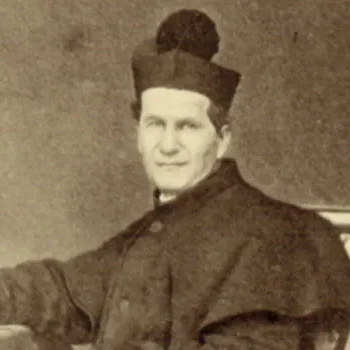
Memorial of Saint John Bosco, Priest
Liturgical Color: White
Rosary Mysteries: Joyful Mysteries
“If one is to do good, he must have a little courage, be ready for sacrifice, deal affably with all and never slight anybody. By following this method I have always had significant success, in fact, marvelous success.”
Saint John Bosco
August 16, 1815 – January 31, 1888
Patron of youth, young people, students, apprentices, and schoolchildren

Daily Readings
First Reading: 2 Samuel 12: 1-7, 10-17
1 And the Lord sent Nathan to David: and when he was come to him, he said to him: There were two men in one city, the one rich, and the other poor.
2 The rich man had exceeding many sheep and oxen.
3 But the poor man had nothing at all but one little ewe lamb, which he had bought and nourished up, and which had grown up in his house together with his children, eating of his bread, and drinking of his cup, and sleeping in his bosom: and it was unto him as a daughter.
4 And when a certain stranger was come to the rich man, he spared to take of his own sheep and oxen, to make a feast for that stranger, who was come to him, but took the poor man’s ewe, and dressed it for the man that was come to him.
5 And David’s anger being exceedingly kindled against that man, he said to Nathan: As the Lord liveth, the man that hath done this is a child of death.
6 He shall restore the ewe fourfold, because he did this thing, and had no pity.
7 And Nathan said to David: Thou art the man. Thus saith the Lord the God of Israel: I anointed thee king over Israel, and I delivered thee from the hand of Saul
10 Therefore the sword shall never depart from thy house, because thou hast despised me, and hast taken the wife of Urias the Hethite to be thy wife.
11 Thus saith the Lord: Behold, I will raise up evil against thee out of thy own house, and I will take thy wives before thy eyes and give them to thy neighhour, and he shall lie with thy wives in the sight of this sun.
12 For thou didst it secretly: but I will do this thing in the sight of all Israel, and in the sight of the sun.
13 And David said to Nathan: I have sinned against the Lord. And Nathan said to David: The Lord also hath taken away thy sin: thou shalt not die.
14 Nevertheless, because thou hast given occasion to the enemies of the Lord to blaspheme, for this thing, the child that is born to thee, shall surely die.
15 And Nathan returned to his house. The Lord also struck the child which the wife of Urias had borne to David, and his life was despaired of.
16 And David besought the Lord for the child: and David kept a fast, and going in by himself lay upon the ground.
17 And the ancients of his house came, to make him rise from the ground: but he would not, neither did he eat meat with them.
1 Misit ergo Dominus Nathan ad David: qui cum venisset ad eum, dixit ei: Duo viri erant in civitate una, unus dives, et alter pauper.
2 Dives habebat oves et boves plurimos valde.
3 Pauper autem nihil habebat omnino, præter ovem unam parvulam quam emerat et nutrierat, et quæ creverat apud eum cum filiis ejus simul, de pane illius comedens, et de calice ejus bibens, et in sinu illius dormiens: eratque illi sicut filia.
4 Cum autem peregrinus quidam venisset ad divitem, parcens ille sumere de ovibus et de bobus suis, ut exhiberet convivium peregrino illi qui venerat ad se, tulit ovem viri pauperis, et præparavit cibos homini qui venerat ad se.
5 Iratus autem indignatione David adversus hominem illum nimis, dixit ad Nathan: Vivit Dominus, quoniam filius mortis est vir qui fecit hoc.
6 Ovem reddet in quadruplum, eo quod fecerit verbum istud, et non pepercerit.
7 Dixit autem Nathan ad David: Tu es ille vir. Hæc dicit Dominus Deus Israël: Ego unxi te in regem super Israël, et ego erui te de manu Saul
10 Quam ob rem non recedet gladius de domo tua usque in sempiternum, eo quod despexeris me, et tuleris uxorem Uriæ Hethæi ut esset uxor tua.
11 Itaque hæc dicit Dominus: Ecce ego suscitabo super te malum de domo tua, et tollam uxores tuas in oculis tuis, et dabo proximo tuo: et dormiet cum uxoribus tuis in oculis solis hujus.
12 Tu enim fecisti abscondite: ego autem faciam verbum istud in conspectu omnis Israël, et in conspectu solis.
13 Et dixit David ad Nathan: Peccavi Domino. Dixitque Nathan ad David: Dominus quoque transtulit peccatum tuum: non morieris.
14 Verumtamen quoniam blasphemare fecisti inimicos Domini, propter verbum hoc, filius qui natus est tibi, morte morietur.
15 Et reversus est Nathan in domum suam. Percussit quoque Dominus parvulum quem pepererat uxor Uriæ David, et desperatus est.
16 Deprecatusque est David Dominum pro parvulo: et jejunavit David jejunio, et ingressus seorsum, jacuit super terram.
17 Venerunt autem seniores domus ejus, cogentes eum ut surgeret de terra: qui noluit, nec comedit cum eis cibum.
Gospel: Mark 4: 35-41
35 And he saith to them that day, when evening was come: Let us pass over to the other side.
36 And sending away the multitude, they take him even as he was in the ship: and there were other ships with him.
37 And there arose a great storm of wind, and the waves beat into the ship, so that the ship was filled.
38 And he was in the hinder part of the ship, sleeping upon a pillow; and they awake him, and say to him: Master, doth it not concern thee that we perish?
39 And rising up, he rebuked the wind, and said to the sea: Peace, be still. And the wind ceased: and there was made a great calm.
40 And he said to them: Why are you fearful? have you not faith yet? And they feared exceedingly: and they said one to another: Who is this (thinkest thou) that both wind and sea obey him?
35 Et ait illis in illa die, cum sero esset factum: Transeamus contra.
36 Et dimittentes turbam, assumunt eum ita ut erat in navi: et aliæ naves erant cum illo.
37 Et facta est procella magna venti, et fluctus mittebat in navim, ita ut impleretur navis.
38 Et erat ipse in puppi super cervical dormiens: et excitant eum, et dicunt illi: Magister, non ad te pertinet, quia perimus?
39 Et exsurgens comminatus est vento, et dixit mari: Tace, obmutesce. Et cessavit ventus: et facta est tranquillitas magna.
40 Et ait illis: Quid timidi estis? necdum habetis fidem? et timuerunt timore magno, et dicebant ad alterutrum: Quis, putas, est iste, quia et ventus et mare obediunt ei?

A Daily Question from the Summa Theologica
Whether the sacraments of the New Law contain grace? (Article 3 of 6 of Question 62. Of the Sacraments’ Principal Effect Which is Grace from the Treatise on the Sacraments)
Objection 1: It seems that the sacraments of the New Law do not contain grace. For it seems that what is contained is in the container. But grace is not in the sacraments; neither as in a subject, because the subject of grace is not a body but a spirit; nor as in a vessel, for according to Phys. iv, “a vessel is a movable place,” and an accident cannot be in a place. Therefore it seems that the sacraments of the New Law do not contain grace.
Objection 2: Further, sacraments are instituted as means whereby men may obtain grace. But since grace is an accident it cannot pass from one subject to another. Therefore it would be of no account if grace were in the sacraments.
Objection 3: Further, a spiritual thing is not contained by a corporeal, even if it be therein; for the soul is not contained by the body; rather does it contain the body. Since, therefore, grace is something spiritual, it seems that it cannot be contained in a corporeal sacrament.
On the contrary, Hugh of S. Victor says (De Sacram. i) that “a sacrament, through its being sanctified, contains an invisible grace.”
I answer that, A thing is said to be in another in various ways; in two of which grace is said to be in the sacraments. First, as in its sign; for a sacrament is a sign of grace. Secondly, as in its cause; for, as stated above (A[1]) a sacrament of the New Law is an instrumental cause of grace. Wherefore grace is in a sacrament of the New Law, not as to its specific likeness, as an effect in its univocal cause; nor as to some proper and permanent form proportioned to such an effect, as effects in non-univocal causes, for instance, as things generated are in the sun; but as to a certain instrumental power transient and incomplete in its natural being, as will be explained later on (A[4]).
Reply to Objection 1: Grace is said to be in a sacrament not as in its subject; nor as in a vessel considered as a place, but understood as the instrument of some work to be done, according to Ezech. 9:1: “Everyone hath a destroying vessel [Douay: ‘weapon’] in his hand.”
Reply to Objection 2: Although an accident does not pass from one subject to another, nevertheless in a fashion it does pass from its cause into its subject through the instrument; not so that it be in each of these in the same way, but in each according to its respective nature.
Reply to Objection 3: If a spiritual thing exist perfectly in something, it contains it and is not contained by it. But, in a sacrament, grace has a passing and incomplete mode of being: and consequently it is not unfitting to say that the sacraments contain grace.
Continue reading the rest of the articles on Sacred Texts Archive website.