Third Sunday of Advent
Liturgical Color: Violet or Rose
Rosary Mysteries: Glorious Mysteries

Daily Readings
First Reading: Isaiah 35:1-6a, 10
Israel’s Deliverance
1 The wilderness and the parched land will exult;
the Arabah will rejoice and bloom;
2 Like the crocus it shall bloom abundantly,
and rejoice with joyful song.
The glory of Lebanon will be given to it,
the splendor of Carmel and Sharon;
They will see the glory of the LORD,
the splendor of our God.
3 Strengthen hands that are feeble,
make firm knees that are weak,
4 Say to the fearful of heart:
Be strong, do not fear!
Here is your God,
he comes with vindication;
With divine recompense
he comes to save you.
5 Then the eyes of the blind shall see,
and the ears of the deaf be opened;
6 Then the lame shall leap like a stag,
and the mute tongue sing for joy.
For waters will burst forth in the wilderness,
and streams in the Arabah.
10 And the ransomed of the LORD shall return,
and enter Zion singing,
crowned with everlasting joy;
They meet with joy and gladness,
sorrow and mourning flee away.
1 [Lætabitur deserta et invia,
et exsultabit solitudo,
et florebit quasi lilium.
2 Germinans germinabit, et exsultabit
lætabunda et laudans:
gloria Libani data est ei,
decor Carmeli et Saron;
ipsi videbunt gloriam Domini,
et decorem Dei nostri.
3 Confortate manus dissolutas,
et genua debilia roborate.
4 Dicite pusillanimis:
Confortamini, et nolite timere:
ecce Deus vester ultionem adducet retributionis;
Deus ipse veniet, et salvabit vos.
5 Tunc aperientur oculi cæcorum,
et aures surdorum patebunt;
6 tunc saliet sicut cervus claudus,
et aperta erit lingua mutorum:
quia scissæ sunt in deserto aquæ,
et torrentes in solitudine;
10 Et redempti a Domino convertentur,
et venient in Sion cum laude,
et lætitia sempiterna super caput eorum:
gaudium et lætitiam obtinebunt,
et fugiet dolor et gemitus.]
Second Reading: James 5:7-10
Patience and Oaths
7 Be patient, therefore, brothers, until the coming of the Lord. See how the farmer waits for the precious fruit of the earth, being patient with it until it receives the early and the late rains.
8 You too must be patient. Make your hearts firm, because the coming of the Lord is at hand.
9 Do not complain, brothers, about one another, that you may not be judged. Behold, the Judge is standing before the gates.
10 Take as an example of hardship and patience, brothers, the prophets who spoke in the name of the Lord.
7 Patientes igitur estote, fratres, usque ad adventum Domini. Ecce agricola exspectat pretiosum fructum terræ, patienter ferens donec accipiat temporaneum et serotinum.
8 Patientes igitur estote et vos, et confirmate corda vestra: quoniam adventus Domini appropinquavit.
9 Nolite ingemiscere, fratres, in alterutrum, ut non judicemini. Ecce judex ante januam assistit.
10 Exemplum accipite, fratres, exitus mali, laboris, et patientiæ, prophetas qui locuti sunt in nomine Domini.
Gospel: Matthew 11:2-11
The Messengers from John the Baptist
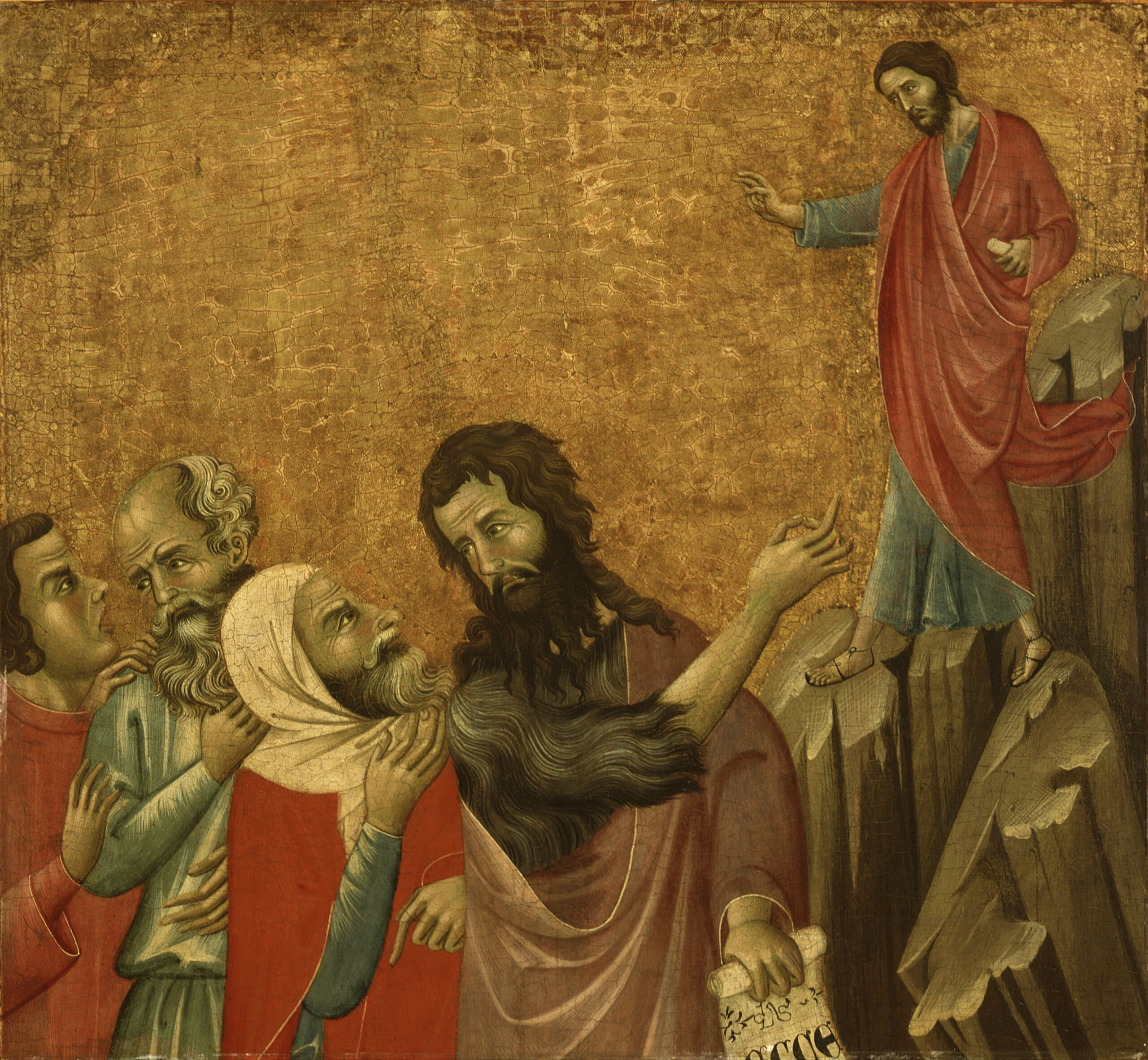
2 When John heard in prison of the works of the Messiah, he sent his disciples to him
3 with this question, “Are you the one who is to come, or should we look for another?”
4 Jesus said to them in reply, “Go and tell John what you hear and see:
5 the blind regain their sight, the lame walk, lepers are cleansed, the deaf hear, the dead are raised, and the poor have the good news proclaimed to them.
6 And blessed is the one who takes no offense at me.”
Jesus’ Testimony to John
7 As they were going off, Jesus began to speak to the crowds about John, “What did you go out to the desert to see? A reed swayed by the wind?
8 Then what did you go out to see? Someone dressed in fine clothing? Those who wear fine clothing are in royal palaces.
9 Then why did you go out? To see a prophet? Yes, I tell you, and more than a prophet.
10 This is the one about whom it is written:
‘Behold, I am sending my messenger ahead of you;
he will prepare your way before you.’
11 Amen, I say to you, among those born of women there has been none greater than John the Baptist; yet the least in the kingdom of heaven is greater than he.
2 Joannes autem cum audisset in vinculis opera Christi, mittens duos de discipulis suis,
3 ait illi: Tu es, qui venturus es, an alium exspectamus?
4 Et respondens Jesus ait illis: Euntes renuntiate Joanni quæ audistis, et vidistis.
5 Cæci vident, claudi ambulant, leprosi mundantur, surdi audiunt, mortui resurgunt, pauperes evangelizantur:
6 et beatus est, qui non fuerit scandalizatus in me.
7 Illis autem abeuntibus, cœpit Jesus dicere ad turbas de Joanne: Quid existis in desertum videre? arundinem vento agitatam?
8 Sed quid existis videre? hominem mollibus vestitum? Ecce qui mollibus vestiuntur, in domibus regum sunt.
9 Sed quid existis videre? prophetam? Etiam dico vobis, et plus quam prophetam.
10 Hic est enim de quo scriptum est: Ecce ego mitto angelum meum ante faciem tuam, qui præparabit viam tuam ante te.
11 Amen dico vobis, non surrexit inter natos mulierum major Joanne Baptista: qui autem minor est in regno cælorum, major est illo.

A Daily Question from the Summa Theologica
Whether it was fitting that John should baptize? (Article 1 of 6 of Question 38. Of the Baptism of John from the Treatise on the Incarnation)
Objection 1: It would seem that it was not fitting that John should baptize. For every sacramental rite belongs to some law. But John did not introduce a new law. Therefore it was not fitting that he should introduce the new rite of baptism.
Objection 2: Further, John “was sent by God . . . for a witness” (John 1:6, 7) as a prophet; according to Lk. 1:76: “Thou, child, shalt be called the prophet of the Highest.” But the prophets who lived before Christ did not introduce any new rite, but persuaded men to observe the rites of the Law. as is clearly stated Malachi 4:4: “Remember the law of Moses My servant.” Therefore neither should John have introduced a new rite of baptism.
Objection 3: Further, when there is too much of anything, nothing should be added to it. But the Jews observed a superfluity of baptisms; for it is written (Mark 7:3, 4) that “the Pharisees and all the Jews eat not without often washing their hands . . . and when they come from the market, unless they be washed, they eat not; and many other things there are that have been delivered to them to observe, the washings of cups and of pots, and of brazen vessels, and of beds.” Therefore it was unfitting that John should baptize.
On the contrary is the authority of Scripture (Matt. 3:5, 6), which, after stating the holiness of John, adds many went out to him, “and were baptized in the Jordan.”
I answer that, It was fitting for John to baptize, for four reasons: first, it was necessary for Christ to be baptized by John, in order that He might sanctify baptism; as Augustine observes, super Joan. (Tract. xiii in Joan.).
Secondly, that Christ might be manifested. Whence John himself says (Jn. 1:31): “That He,” i.e. Christ, “may be made manifest in Israel, therefore am I come baptizing with water.” For he announced Christ to the crowds that gathered around him; which was thus done much more easily than if he had gone in search of each individual, as Chrysostom observes, commenting on St. John (Hom. x in Matth.).
Thirdly, that by his baptism he might accustom men to the baptism of Christ; wherefore Gregory says in a homily (Hom. vii in Evang.) that therefore did John baptize, “that, being consistent with his office of precursor, as he had preceded our Lord in birth, so he might also by baptizing precede Him who was about to baptize.”
Fourthly, that by persuading men to do penance, he might prepare men to receive worthily the baptism of Christ. Wherefore Bede [*Cf. Scot. Erig. in Joan. iii, 24] says that “the baptism of John was as profitable before the baptism of Christ, as instruction in the faith profits the catechumens not yet baptized. For just as he preached penance, and foretold the baptism of Christ, and drew men to the knowledge of the Truth that hath appeared to the world, so do the ministers of the Church, after instructing men, chide them for their sins, and lastly promise them forgiveness in the baptism of Christ.”
Reply to Objection 1: The baptism of John was not a sacrament properly so called [per se], but a kind of sacramental, preparatory to the baptism of Christ. Consequently, in a way, it belonged to the law of Christ, but not to the law of Moses.
Reply to Objection 2: John was not only a prophet, but “more than a prophet,” as stated Mat. 11:9: for he was the term of the Law and the beginning of the Gospel. Therefore it was in his province to lead men, both by word and deed, to the law of Christ rather than to the observance of the Old Law.
Reply to Objection 3: Those baptisms of the Pharisees were vain, being ordered merely unto carnal cleanliness. But the baptism of John was ordered unto spiritual cleanliness, since it led men to do penance, as stated above.
Continue reading the rest of the articles on Sacred Texts Archive website.
Scripture texts in this work are taken from the New American Bible, revised edition © 2010, 1991, 1986, 1970 Confraternity of Christian Doctrine, Washington, D.C.