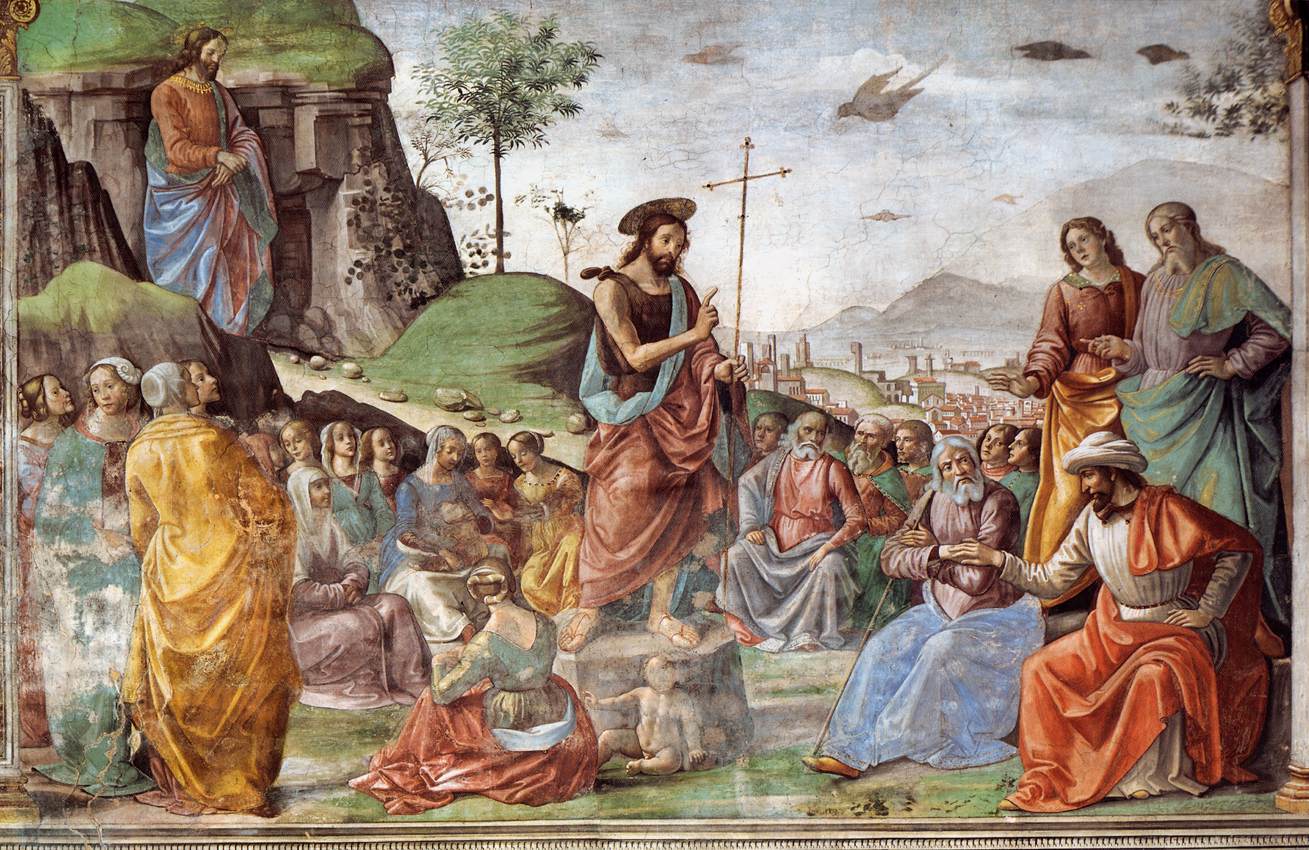
Second Sunday of Advent
Liturgical Color: Violet
Rosary Mysteries: Glorious Mysteries

Daily Readings
First Reading: Isaiah 11:1-10
The Ideal Davidic King
1 But a shoot shall sprout from the stump of Jesse,
and from his roots a bud shall blossom.
2 The spirit of the LORD shall rest upon him:
a spirit of wisdom and of understanding,
A spirit of counsel and of strength,
a spirit of knowledge and of fear of the LORD,
3 and his delight shall be the fear of the LORD.
Not by appearance shall he judge,
nor by hearsay shall he decide,
4 But he shall judge the poor with justice,
and decide fairly for the land’s afflicted.
He shall strike the ruthless with the rod of his mouth,
and with the breath of his lips he shall slay the wicked.
5 Justice shall be the band around his waist,
and faithfulness a belt upon his hips.
6 Then the wolf shall be a guest of the lamb,
and the leopard shall lie down with the young goat;
The calf and the young lion shall browse together,
with a little child to guide them.
7 The cow and the bear shall graze,
together their young shall lie down;
the lion shall eat hay like the ox.
8 The baby shall play by the viper’s den,
and the child lay his hand on the adder’s lair.
9 They shall not harm or destroy on all my holy mountain;
for the earth shall be filled with knowledge of the LORD,
as water covers the sea.
Restoration
10 On that day,
The root of Jesse,
set up as a signal for the peoples—
Him the nations will seek out;
his dwelling shall be glorious.
1 [Et egredietur virga de radice Jesse,
et flos de radice ejus ascendet.
2 Et requiescet super eum spiritus Domini:
spiritus sapientiæ et intellectus,
spiritus consilii et fortitudinis,
spiritus scientiæ et pietatis;
3 et replebit eum spiritus timoris Domini.
Non secundum visionem oculorum judicabit,
neque secundum auditum aurium arguet;
4 sed judicabit in justitia pauperes,
et arguet in æquitate pro mansuetis terræ;
et percutiet terram virga oris sui,
et spiritu labiorum suorum interficiet impium.
5 Et erit justitia cingulum lumborum ejus,
et fides cinctorium renum ejus.
6 Habitabit lupus cum agno,
et pardus cum hædo accubabit;
vitulus, et leo, et ovis, simul morabuntur,
et puer parvulus minabit eos.
7 Vitulus et ursus pascentur,
simul requiescent catuli eorum;
et leo quasi bos comedet paleas.
8 Et delectabitur infans ab ubere super foramine aspidis;
et in caverna reguli
qui ablactatus fuerit manum suam mittet.
9 Non nocebunt, et non occident
in universo monte sancto meo,
quia repleta est terra scientia Domini, sicut aquæ maris operientes.]
10 [In die illa radix Jesse,
qui stat in signum populorum,
ipsum gentes deprecabuntur,
et erit sepulchrum ejus gloriosum.
Second Reading: Romans 15:4-9
4 For whatever was written previously was written for our instruction, that by endurance and by the encouragement of the scriptures we might have hope.
5 May the God of endurance and encouragement grant you to think in harmony with one another, in keeping with Christ Jesus,
6 that with one accord you may with one voice glorify the God and Father of our Lord Jesus Christ.
God’s Fidelity and Mercy
7 Welcome one another, then, as Christ welcomed you, for the glory of God.
8 For I say that Christ became a minister of the circumcised to show God’s truthfulness, to confirm the promises to the patriarchs,
9 but so that the Gentiles might glorify God for his mercy. As it is written:
“Therefore, I will praise you among the Gentiles
and sing praises to your name.”
4 Quæcumque enim scripta sunt, ad nostram doctrinam scripta sunt: ut per patientiam, et consolationem Scripturarum, spem habeamus.
5 Deus autem patientiæ et solatii det vobis idipsum sapere in alterutrum secundum Jesum Christum:
6 ut unanimes, uno ore honorificetis Deum et patrem Domini nostri Jesu Christi.
7 Propter quod suscipite invicem, sicut et Christus suscepit vos in honorem Dei.
8 Dico enim Christum Jesum ministrum fuisse circumcisionis propter veritatem Dei, ad confirmandas promissiones patrum:
9 gentes autem super misericordia honorare Deum, sicut scriptum est: Propterea confitebor tibi in gentibus, Domine, et nomini tuo cantabo.
Gospel: Matthew 3:1-12
The Preaching of John the Baptist
1 In those days John the Baptist appeared, preaching in the desert of Judea
2 [and] saying, “Repent, for the kingdom of heaven is at hand!”
3 It was of him that the prophet Isaiah had spoken when he said:
“A voice of one crying out in the desert,
‘Prepare the way of the Lord,
make straight his paths.’”
4 John wore clothing made of camel’s hair and had a leather belt around his waist. His food was locusts and wild honey.
5 At that time Jerusalem, all Judea, and the whole region around the Jordan were going out to him
6 and were being baptized by him in the Jordan River as they acknowledged their sins.
7 When he saw many of the Pharisees and Sadducees coming to his baptism, he said to them, “You brood of vipers! Who warned you to flee from the coming wrath?
8 Produce good fruit as evidence of your repentance.
9 And do not presume to say to yourselves, ‘We have Abraham as our father.’ For I tell you, God can raise up children to Abraham from these stones.
10 Even now the ax lies at the root of the trees. Therefore every tree that does not bear good fruit will be cut down and thrown into the fire.
11 I am baptizing you with water, for repentance, but the one who is coming after me is mightier than I. I am not worthy to carry his sandals. He will baptize you with the holy Spirit and fire.
12 His winnowing fan is in his hand. He will clear his threshing floor and gather his wheat into his barn, but the chaff he will burn with unquenchable fire.”
1 In diebus autem illis venit Joannes Baptista prædicans in deserto Judææ,
2 et dicens: Pœnitentiam agite: appropinquavit enim regnum cælorum.
3 Hic est enim, qui dictus est per Isaiam prophetam dicentem: [Vox clamantis in deserto:
Parate viam Domini;
rectas facite semitas ejus.]
4 Ipse autem Joannes habebat vestimentum de pilis camelorum, et zonam pelliceam circa lumbos suos: esca autem ejus erat locustæ, et mel silvestre.
5 Tunc exibat ad eum Jerosolyma, et omnis Judæa, et omnis regio circa Jordanem;
6 et baptizabantur ab eo in Jordane, confitentes peccata sua.
7 Videns autem multos pharisæorum, et sadducæorum, venientes ad baptismum suum, dixit eis: Progenies viperarum, quis demonstravit vobis fugere a ventura ira?
8 Facite ergo fructum dignum pœnitentiæ.
9 Et ne velitis dicere intra vos: Patrem habemus Abraham. Dico enim vobis quoniam potens est Deus de lapidibus istis suscitare filios Abrahæ.
10 Jam enim securis ad radicem arborum posita est. Omnis ergo arbor, quæ non facit fructum bonum, excidetur, et in ignem mittetur.
11 Ego quidem baptizo vos in aqua in pœnitentiam: qui autem post me venturus est, fortior me est, cujus non sum dignus calceamenta portare: ipse vos baptizabit in Spiritu Sancto, et igni.
12 Cujus ventilabrum in manu sua: et permundabit aream suam: et congregabit triticum suum in horreum, paleas autem comburet igni inextinguibili.

A Daily Question from the Summa Theologica
Whether the Blessed Virgin was sanctified before her birth from the womb? (Article 1 of 6 of Question 27. Of the Sanctification of the Blessed Virigin from the Treatise on the Incarnation)
Objection 1: It would seem that the Blessed Virgin was not sanctified before her birth from the womb. For the Apostle says (1 Cor. 15:46): “That was not first which is spiritual but that which is natural; afterwards that which is spiritual.” But by sanctifying grace man is born spiritually into a son of God according to Jn. 1:13: “(who) are born of God.” But birth from the womb is a natural birth. Therefore the Blessed Virgin was not sanctified before her birth from the womb.
Objection 2: Further, Augustine says (Ep. ad Dardan.): “The sanctification, by which we become temples of God, is only of those who are born again.” But no one is born again, who was not born previously. Therefore the Blessed Virgin was not sanctified before her birth from the womb.
Objection 3: Further, whoever is sanctified by grace is cleansed from sin, both original and actual. If, therefore, the Blessed Virgin was sanctified before her birth from the womb, it follows that she was then cleansed from original sin. Now nothing but original sin could hinder her from entering the heavenly kingdom. If therefore she had died then, it seems that she would have entered the gates of heaven. But this was not possible before the Passion of Christ, according to the Apostle (Heb. 10:19): “We have [Vulg.: ‘having’] therefore a confidence in the entering into the Holies by His blood.” It seems therefore that the Blessed Virgin was not sanctified before her birth from the womb.
Objection 4: Further, original sin is contracted through the origin, just as actual sin is contracted through an act. But as long as one is in the act of sinning, one cannot be cleansed from actual sin. Therefore neither could the Blessed Virgin be cleansed from original sin as long as she was in the act of origin, by existence in her mother’s womb.
On the contrary, The Church celebrates the feast of our Lady’s Nativity. Now the Church does not celebrate feasts except of those who are holy. Therefore even in her birth the Blessed Virgin was holy. Therefore she was sanctified in the womb.
I answer that, Nothing is handed down in the canonical Scriptures concerning the sanctification of the Blessed Mary as to her being sanctified in the womb; indeed, they do not even mention her birth. But as Augustine, in his tractate on the Assumption of the Virgin, argues with reason, since her body was assumed into heaven, and yet Scripture does not relate this; so it may be reasonably argued that she was sanctified in the womb. For it is reasonable to believe that she, who brought forth “the Only-Begotten of the Father full of grace and truth,” received greater privileges of grace than all others: hence we read (Lk. 1:28) that the angel addressed her in the words: “Hail full of grace!”
Moreover, it is to be observed that it was granted, by way of privilege, to others, to be sanctified in the womb; for instance, to Jeremias, to whom it was said (Jer. 1:5): “Before thou camest forth out of the womb, I sanctified thee”; and again, to John the Baptist, of whom it is written (Lk. 1:15): “He shall be filled with the Holy Ghost even from his mother’s womb.” It is therefore with reason that we believe the Blessed Virgin to have been sanctified before her birth from the womb.
Reply to Objection 1: Even in the Blessed Virgin, first was that which is natural, and afterwards that which is spiritual: for she was first conceived in the flesh, and afterwards sanctified in the spirit.
Reply to Objection 2: Augustine speaks according to the common law, by reason of which no one is regenerated by the sacraments, save those who are previously born. But God did not so limit His power to the law of the sacraments, but that He can bestow His grace, by special privilege, on some before they are born from the womb.
Reply to Objection 3: The Blessed Virgin was sanctified in the womb from original sin, as to the personal stain; but she was not freed from the guilt to which the whole nature is subject, so as to enter into Paradise otherwise than through the Sacrifice of Christ; the same also is to be said of the Holy Fathers who lived before Christ.
Reply to Objection 4: Original sin is transmitted through the origin, inasmuch as through the origin the human nature is transmitted, and original sin, properly speaking, affects the nature. And this takes place when the off-spring conceived is animated. Wherefore nothing hinders the offspring conceived from being sanctified after animation: for after this it remains in the mother’s womb not for the purpose of receiving human nature, but for a certain perfecting of that which it has already received.
Continue reading the rest of the articles on Sacred Texts Archive website.
Scripture texts in this work are taken from the New American Bible, revised edition © 2010, 1991, 1986, 1970 Confraternity of Christian Doctrine, Washington, D.C.