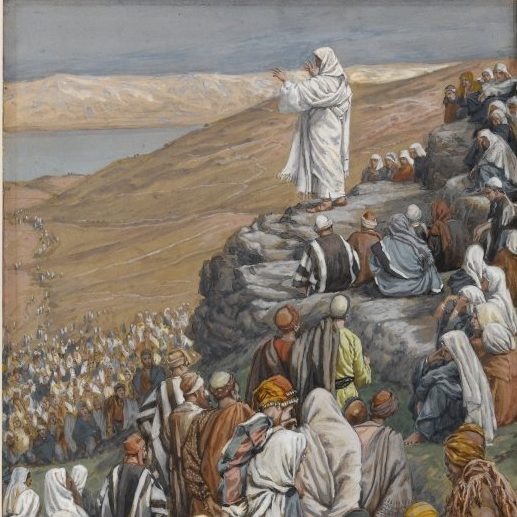
Fourth Sunday in Ordinary Time
Liturgical Color: Green
Rosary Mysteries: Glorious Mysteries

Daily Readings
First Reading: Zephaniah 2: 3, 3: 12-13
3 Seek the Lord, all ye meek of the earth, you that have wrought his judgment: seek the just, seek the meek: if by any means you may be hid in the day of the Lord’s indignation.
12 And I will leave in the midst of thee a poor and needy people: and they shall hope in the name of the Lord.
13 The remnant of Israel shall not do iniquity, nor speak lies, nor shall a deceitful tongue be found in their mouth: for they shall feed, and shall lie down, and there shall be none to make them afraid.
3 Quærite Dominum, omnes mansueti terræ,
qui judicium ejus estis operati;
quærite justum, quærite mansuetum,
si quomodo abscondamini in die furoris Domini.
12 Et derelinquam in medio tui populum pauperem et egenum:
et sperabunt in nomine Domini.
13 Reliquiæ Israël non facient iniquitatem,
nec loquentur mendacium,
et non invenietur in ore eorum lingua dolosa,
quoniam ipsi pascentur, et accubabunt,
et non erit qui exterreat.
Second Reading: 1 Corinthians 1: 26-31
26 For see your vocation, brethren, that there are not many wise according to the flesh, not many mighty, not many noble:
27 But the foolish things of the world hath God chosen, that he may confound the wise; and the weak things of the world hath God chosen, that he may confound the strong.
28 And the base things of the world, and the things that are contemptible, hath God chosen, and things that are not, that he might bring to nought things that are:
29 That no flesh should glory in his sight.
30 But of him are you in Christ Jesus, who of God is made unto us wisdom, and justice, and sanctification, and redemption:
31 That, as it is written: He that glorieth, may glory in the Lord.
26 Videte enim vocationem vestram, fratres, quia non multi sapientes secundum carnem, non multi potentes, non multi nobiles:
27 sed quæ stulta sunt mundi elegit Deus, ut confundat sapientes: et infirma mundi elegit Deus, ut confundat fortia:
28 et ignobilia mundi, et contemptibilia elegit Deus, et ea quæ non sunt, ut ea quæ sunt destrueret:
29 ut non glorietur omnis caro in conspectu ejus.
30 Ex ipso autem vos estis in Christo Jesu, qui factus est nobis sapientia a Deo, et justitia, et sanctificatio, et redemptio:
31 ut quemadmodum scriptum est: Qui gloriatur, in Domino glorietur.
Gospel: Matthew 5: 1-12
1 And seeing the multitudes, he went up into a mountain, and when he was set down, his disciples came unto him.
2 And opening his mouth, he taught them, saying:
3 Blessed are the poor in spirit: for theirs is the kingdom of heaven.
4 Blessed are the meek: for they shall possess the land.
5 Blessed are they that mourn: for they shall be comforted.
6 Blessed are they that hunger and thirst after justice: for they shall have their fill.
7 Blessed are the merciful: for they shall obtain mercy.
8 Blessed are the clean of heart: for they shall see God.
9 Blessed are the peacemakers: for they shall be called children of God.
10 Blessed are they that suffer persecution for justice’ sake: for theirs is the kingdom of heaven.
11 Blessed are ye when they shall revile you, and persecute you, and speak all that is evil against you, untruly, for my sake:
12 Be glad and rejoice, for your reward is very great in heaven. For so they persecuted the prophets that were before you.
1 Videns autem Jesus turbas, ascendit in montem, et cum sedisset, accesserunt ad eum discipuli ejus,
2 et aperiens os suum docebat eos dicens:
3 Beati pauperes spiritu: quoniam ipsorum est regnum cælorum.
4 Beati mites: quoniam ipsi possidebunt terram.
5 Beati qui lugent: quoniam ipsi consolabuntur.
6 Beati qui esuriunt et sitiunt justitiam: quoniam ipsi saturabuntur.
7 Beati misericordes: quoniam ipsi misericordiam consequentur.
8 Beati mundo corde: quoniam ipsi Deum videbunt.
9 Beati pacifici: quoniam filii Dei vocabuntur.
10 Beati qui persecutionem patiuntur propter justitiam: quoniam ipsorum est regnum cælorum.
11 Beati estis cum maledixerint vobis, et persecuti vos fuerint, et dixerint omne malum adversum vos mentientes, propter me:
12 gaudete, et exsultate, quoniam merces vestra copiosa est in cælis. Sic enim persecuti sunt prophetas, qui fuerunt ante vos.

A Daily Question from the Summa Theologica
Whether there be in the sacraments a power of causing grace? (Article 4 of 6 of Question 62. Of the Sacraments’ Principal Effect Which is Grace from the Treatise on the Sacraments)
Objection 1: It seems that there is not in the sacraments a power of causing grace. For the power of causing grace is a spiritual power. But a spiritual power cannot be in a body; neither as proper to it, because power flows from a thing’s essence and consequently cannot transcend it; nor as derived from something else, because that which is received into anything follows the mode of the recipient. Therefore in the sacraments there is no power of causing grace.
Objection 2: Further, whatever exists is reducible to some kind of being and some degree of good. But there is no assignable kind of being to which such a power can belong; as anyone may see by running. through them all. Nor is it reducible to some degree of good; for neither is it one of the goods of least account, since sacraments are necessary for salvation: nor is it an intermediate good, such as are the powers of the soul, which are natural powers; nor is it one of the greater goods, for it is neither grace nor a virtue of the mind. Therefore it seems that in the sacraments there is no power of causing grace.
Objection 3: Further, if there be such a power in the sacraments, its presence there must be due to nothing less than a creative act of God. But it seems unbecoming that so excellent a being created by God should cease to exist as soon as the sacrament is complete. Therefore it seems that in the sacraments there is no power for causing grace.
Objection 4: Further, the same thing cannot be in several. But several things concur in the completion of a sacrament, namely, words and things: while in one sacrament there can be but one power. Therefore it seems that there is no power of causing grace in the sacraments.
On the contrary, Augustine says (Tract. lxxx in Joan.): “Whence hath water so great power, that it touches the body and cleanses the heart?” And Bede says that “Our Lord conferred a power of regeneration on the waters by the contact of His most pure body.”
I answer that, Those who hold that the sacraments do not cause grace save by a certain coincidence, deny the sacraments any power that is itself productive of the sacramental effect, and hold that the Divine power assists the sacraments and produces their effect. But if we hold that a sacrament is an instrumental cause of grace, we must needs allow that there is in the sacraments a certain instrumental power of bringing about the sacramental effects. Now such power is proportionate to the instrument: and consequently it stands in comparison to the complete and perfect power of anything, as the instrument to the principal agent. For an instrument, as stated above (A[1]), does not work save as moved by the principal agent, which works of itself. And therefore the power of the principal agent exists in nature completely and perfectly: whereas the instrumental power has a being that passes from one thing into another, and is incomplete; just as motion is an imperfect act passing from agent to patient.
Reply to Objection 1: A spiritual power cannot be in a corporeal subject, after the manner of a permanent and complete power, as the argument proves. But there is nothing to hinder an instrumental spiritual power from being in a body; in so far as a body can be moved by a particular spiritual substance so as to produce a particular spiritual effect; thus in the very voice which is perceived by the senses there is a certain spiritual power, inasmuch as it proceeds from a mental concept, of arousing the mind of the hearer. It is in this way that a spiritual power is in the sacraments, inasmuch as they are ordained by God unto the production of a spiritual effect.
Reply to Objection 2: Just as motion, through being an imperfect act, is not properly in a genus, but is reducible to a genus of perfect act, for instance, alteration to the genus of quality: so, instrumental power, properly speaking, is not in any genus, but is reducible to a genus and species of perfect act.
Reply to Objection 3: Just as an instrumental power accrues to an instrument through its being moved by the principal agent, so does a sacrament receive spiritual power from Christ’s blessing and from the action of the minister in applying it to a sacramental use. Hence Augustine says in a sermon on the Epiphany (St. Maximus of Turin, Serm. xii): “Nor should you marvel, if we say that water, a corporeal substance, achieves the cleansing of the soul. It does indeed, and penetrates every secret hiding-place of the conscience. For subtle and clear as it is, the blessing of Christ makes it yet more subtle, so that it permeates into the very principles of life and searches the inner-most recesses of the heart.”
Reply to Objection 4: Just as the one same power of the principal agent is instrumentally in all the instruments that are ordained unto the production of an effect, forasmuch as they are one as being so ordained: so also the one same sacramental power is in both words and things, forasmuch as words and things combine to form one sacrament.
Continue reading the rest of the articles on Sacred Texts Archive website.