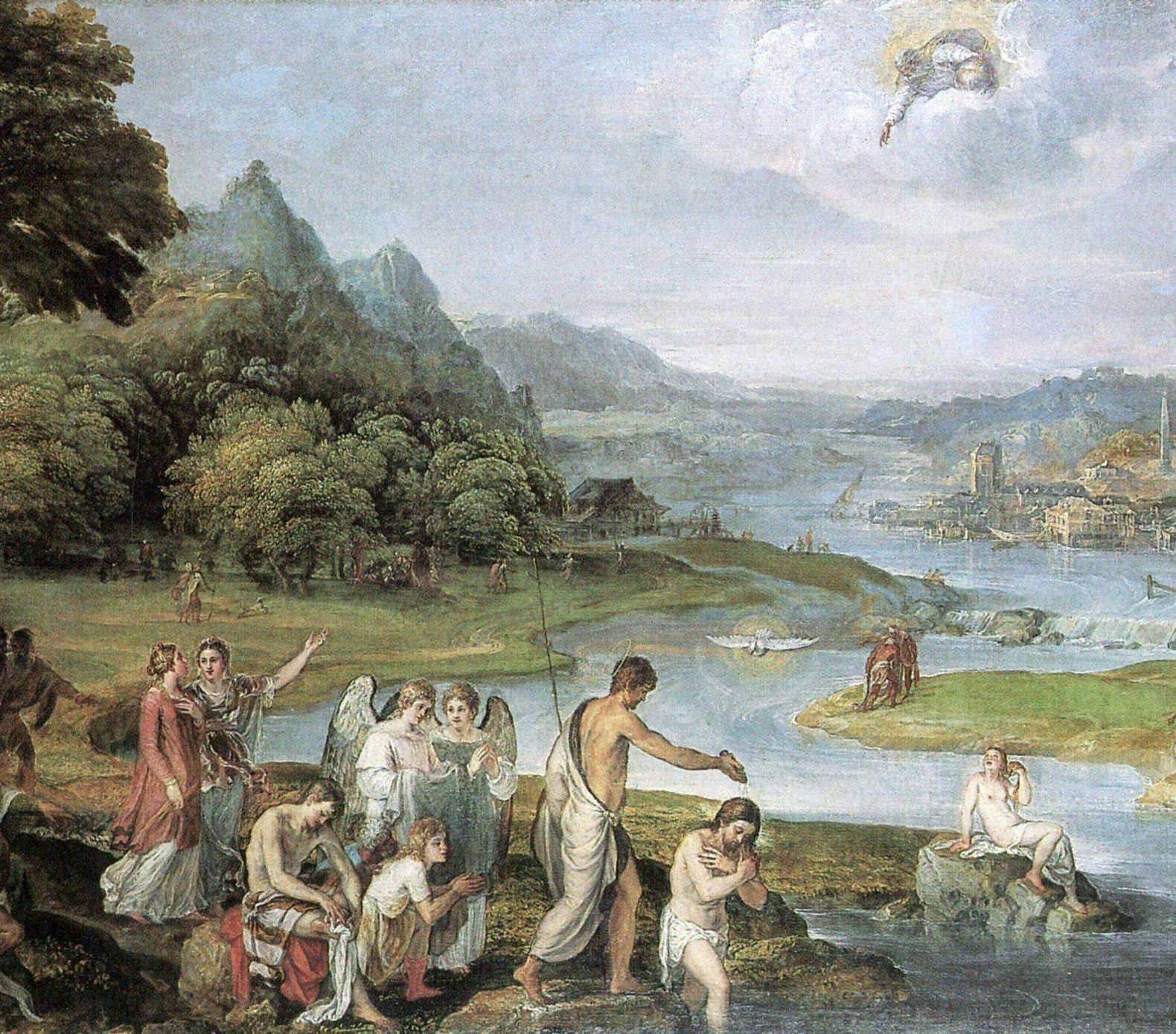
The Baptism of the Lord
Liturgical Color: White
Rosary Mysteries: Glorious Mysteries

Daily Readings
First Reading: Isaiah 42: 1-4, 6-7
1 Behold my servant, I will uphold him: my elect, my soul delighteth in him: I have given my spirit upon him, he shall bring forth judgment to the Gentiles.
2 He shall not cry, nor have respect to person, neither shall his voice be heard abroad.
3 The bruised reed he shall not break, and smoking flax he shall not quench: he shall bring forth judgment unto truth.
4 He shall not be sad, nor troublesome, till he set judgment in the earth: and the islands shall wait for his law.
6 I the Lord have called thee in justice, and taken thee by the hand, and preserved thee. And I have given thee for a covenant of the people, for a light of the Gentiles:
7 That thou mightest open the eyes of the blind, and bring forth the prisoner out of prison, and them that sit in darkness out of the prison house.
1 [Ecce servus meus, suscipiam eum;
electus meus, complacuit sibi in illo anima mea:
dedi spiritum meum super eum:
judicium gentibus proferet.
2 Non clamabit, neque accipiet personam,
nec audietur vox ejus foris.
3 Calamum quassatum non conteret,
et linum fumigans non extinguet:
in veritate educet judicium.
4 Non erit tristis, neque turbulentus,
donec ponat in terra judicium;
et legem ejus insulæ exspectabunt.
6 Ego Dominus vocavi te in justitia,
et apprehendi manum tuam,
et servavi te:
et dedi te in fœdus populi,
in lucem gentium,
7 ut aperires oculos cæcorum,
et educeres de conclusione vinctum,
de domo carceris sedentes in tenebris.
Second Reading: Acts 10: 34-38
34 And Peter opening his mouth, said: In very deed I perceive, that God is not a respecter of persons.
35 But in every nation, he that feareth him, and worketh justice, is acceptable to him.
36 God sent the word to the children of Israel, preaching peace by Jesus Christ: (he is Lord of all.)
37 You know the word which hath been published through all Judea: for it began from Galilee, after the baptism which John preached,
38 Jesus of Nazareth: how God anointed him with the Holy Ghost, and with power, who went about doing good, and healing all that were oppressed by the devil, for God was with him.
34 Aperiens autem Petrus os suum, dixit: In veritate comperi quia non est personarum acceptor Deus;
35 sed in omni gente qui timet eum, et operatur justitiam, acceptus est illi.
36 Verbum misit Deus filiis Israël, annuntians pacem per Jesum Christum (hic est omnium Dominus).
37 Vos scitis quod factum est verbum per universam Judæam: incipiens enim a Galilæa post baptismum quod prædicavit Joannes,
38 Jesum a Nazareth: quomodo unxit eum Deus Spiritu Sancto, et virtute, qui pertransiit benefaciendo, et sanando omnes oppressos a diabolo, quoniam Deus erat cum illo.
Gospel: Matthew 3: 13-17
13 Then cometh Jesus from Galilee to the Jordan, unto John, to be baptized by him.
14 But John stayed him, saying: I ought to be baptized by thee, and comest thou to me?
15 And Jesus answering, said to him: Suffer it to be so now. For so it becometh us to fulfill all justice. Then he suffered him.
16 And Jesus being baptized, forthwith came out of the water: and lo, the heavens were opened to him: and he saw the Spirit of God descending as a dove, and coming upon him.
17 And behold a voice from heaven, saying: This is my beloved Son, in whom I am well pleased.
13 Tunc venit Jesus a Galilæa in Jordanem ad Joannem, ut baptizaretur ab eo.
14 Joannes autem prohibebat eum, dicens: Ego a te debeo baptizari, et tu venis ad me?
15 Respondens autem Jesus, dixit ei: Sine modo: sic enim decet nos implere omnem justitiam. Tunc dimisit eum.
16 Baptizatus autem Jesus, confestim ascendit de aqua, et ecce aperti sunt ei cæli: et vidit Spiritum Dei descendentem sicut columbam, et venientem super se.
17 Et ecce vox de cælis dicens: Hic est Filius meus dilectus, in quo mihi complacui.

A Daily Question from the Summa Theologica
Whether John’s baptism should have ceased after Christ was baptized? (Article 5 of 6 of Question 38. Of the Baptism of John from the Treatise on the Incarnation)
Objection 1: It would seem that John’s baptism should have ceased after Christ was baptized. For it is written (Jn. 1:31): “That He may be made manifest in Israel, therefore am I come baptizing in water.” But when Christ had been baptized, He was made sufficiently manifest, both by the testimony of John and by the dove coming down upon Him, and again by the voice of the Father bearing witness to Him. Therefore it seems that John’s baptism should not have endured thereafter.
Objection 2: Further, Augustine says (Super Joan., Tract. iv): “Christ was baptized, and John’s baptism ceased to avail.” Therefore it seems that, after Christ’s baptism, John should not have continued to baptize.
Objection 3: Further, John’s baptism prepared the way for Christ’s. But Christ’s baptism began as soon as He had been baptized; because “by the touch of His most pure flesh He endowed the waters with a regenerating virtue,” as Bede asserts (Mag. Sent. iv, 3). Therefore it seems that John’s baptism ceased when Christ had been baptized.
On the contrary, It is written (John 3:22, 23): “Jesus . . . came into the land of Judea . . . and baptized: and John also was baptizing.” But Christ did not baptize before being baptized. Therefore it seems that John continued to baptize after Christ had been baptized.
I answer that, It was not fitting for the baptism of John to cease when Christ had been baptized. First, because, as Chrysostom says (Hom. xxix in Joan.), “if John had ceased to baptize” when Christ had been baptized, “men would think that he was moved by jealousy or anger.” Secondly, if he had ceased to baptize when Christ baptized, “he would have given His disciples a motive for yet greater envy.” Thirdly, because, by continuing to baptize, “he sent his hearers to Christ” (Hom. xxix in Joan.). Fourthly, because, as Bede [*Scot. Erig. Comment. in Joan.] says, “there still remained a shadow of the Old Law: nor should the forerunner withdraw until the truth be made manifest.”
Reply to Objection 1: When Christ was baptized, He was not as yet fully manifested: consequently there was still need for John to continue baptizing.
Reply to Objection 2: The baptism of John ceased after Christ had been baptized, not immediately, but when the former was cast into prison. Thus Chrysostom says (Hom. xxix in Joan.): “I consider that John’s death was allowed to take place, and that Christ’s preaching began in a great measure after John had died, so that the undivided allegiance of the multitude was transferred to Christ, and there was no further motive for the divergence of opinions concerning both of them.”
Reply to Objection 3: John’s baptism prepared the way not only for Christ to be baptized, but also for others to approach to Christ’s baptism: and this did not take place as soon as Christ was baptized.
Continue reading the rest of the articles on Sacred Texts Archive website.