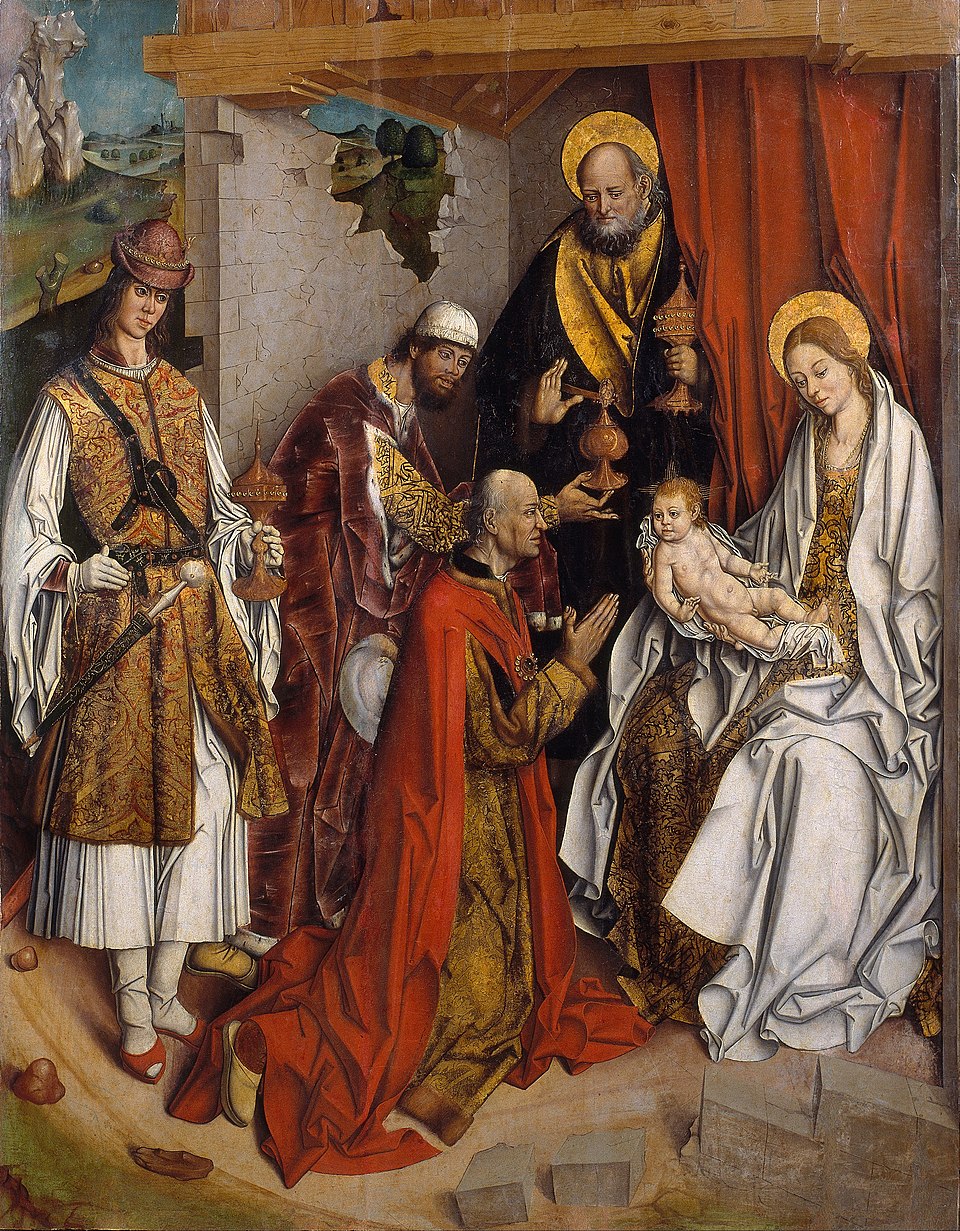
The Epiphany of the lord
Liturgical Color: White
Rosary Mysteries: Glorious Mysteries

Daily Readings
First Reading: Isaiah 60: 1-6
1 Arise, be enlightened, O Jerusalem: for thy light is come, and the glory of the Lord is risen upon thee.
2 For behold darkness shall cover the earth, and a mist the people: but the Lord shall arise upon thee, and his glory shall be seen upon thee.
3 And the Gentiles shall walk in thy light, and kings in the brightness of thy rising.
4 Lift up thy eyes round about, and see: all these are gathered together, they are come to thee: thy sons shall come from afar, and thy daughters shall rise up at thy side.
5 Then shalt thou see, and abound, and thy heart shall wonder and be enlarged, when the multitude of the sea shall be converted to thee, the. strength of the Gentiles shall come to thee.
6 The multitude of camels shall cover thee, the dromedaries of Madian and Epha: all they from Saba shall come, bringing gold and frankincense: and shewing forth praise to the Lord.
1 [Surge, illuminare, Jerusalem, quia venit lumen tuum,
et gloria Domini super te orta est.
2 Quia ecce tenebræ operient terram,
et caligo populos;
super te autem orietur Dominus,
et gloria ejus in te videbitur.
3 Et ambulabunt gentes in lumine tuo,
et reges in splendore ortus tui.
4 Leva in circuitu oculos tuos, et vide:
omnes isti congregati sunt, venerunt tibi;
filii tui de longe venient
et filiæ tuæ de latere surgent.
5 Tunc videbis, et afflues;
mirabitur et dilatabitur cor tuum:
quando conversa fuerit ad te multitudo maris;
fortitudo gentium venerit tibi.
6 Inundatio camelorum operiet te,
dromedarii Madian et Epha;
omnes de Saba venient,
aurum et thus deferentes,
et laudem Domino annuntiantes.
Second Reading: Ephesians 3: 2-3a, 5-6
2 If yet you have heard of the dispensation of the grace of God which is given me towards you:
3 How that, according to revelation, the mystery has been made known to me, as I have written above in a few words;
5 Which in other generations was not known to the sons of men, as it is now revealed to his holy apostles and prophets in the Spirit:
6 That the Gentiles should be fellow heirs, and of the same body, and co-partners of his promise in Christ Jesus, by the gospel:
2 si tamen audistis dispensationem gratiæ Dei, quæ data est mihi in vobis:
3 quoniam secundum revelationem notum mihi factum est sacramentum, sicut supra scripsi in brevi,
5 quod aliis generationibus non est agnitum filiis hominum, sicuti nunc revelatum est sanctis apostolis ejus et prophetis in Spiritu,
6 gentes esse cohæredes, et concorporales, et comparticipes promissionis ejus in Christo Jesu per Evangelium:
Gospel: Matthew 2: 1-12
1 When Jesus therefore was born in Bethlehem of Juda, in the days of king Herod, behold, there came wise men from the east to Jerusalem.
2 Saying, Where is he that is born king of the Jews? For we have seen his star in the east, and are come to adore him.
3 And king Herod hearing this, was troubled, and all Jerusalem with him.
4 And assembling together all the chief priests and the scribes of the people, he inquired of them where Christ should be born.
5 But they said to him: In Bethlehem of Juda. For so it is written by the prophet:
6 And thou Bethlehem the land of Juda art not the least among the princes of Juda: for out of thee shall come forth the captain that shall rule my people Israel.
7 Then Herod, privately calling the wise men, learned diligently of them the time of the star which appeared to them;
8 And sending them into Bethlehem, said: Go and diligently inquire after the child, and when you have found him, bring me word again, that I also may come to adore him.
9 Who having heard the king, went their way; and behold the star which they had seen in the east, went before them, until it came and stood over where the child was.
10 And seeing the star they rejoiced with exceeding great joy.
11 And entering into the house, they found the child with Mary his mother, and falling down they adored him; and opening their treasures, they offered him gifts; gold, frankincense, and myrrh.
12 And having received an answer in sleep that they should not return to Herod, they went back another way into their country.
1 Cum ergo natus esset Jesus in Bethlehem Juda in diebus Herodis regis, ecce magi ab oriente venerunt Jerosolymam,
2 dicentes: Ubi est qui natus est rex Judæorum? vidimus enim stellam ejus in oriente, et venimus adorare eum.
3 Audiens autem Herodes rex, turbatus est, et omnis Jerosolyma cum illo.
4 Et congregans omnes principes sacerdotum, et scribas populi, sciscitabatur ab eis ubi Christus nasceretur.
5 At illi dixerunt: In Bethlehem Judæ: sic enim scriptum est per prophetam:
6 [Et tu Bethlehem terra Juda,
nequaquam minima es
in principibus Juda:
ex te enim exiet dux, qui regat populum meum Israël.]
7 Tunc Herodes clam vocatis magis diligenter didicit ab eis tempus stellæ, quæ apparuit eis:
8 et mittens illos in Bethlehem, dixit: Ite, et interrogate diligenter de puero: et cum inveneritis, renuntiate mihi, ut et ego veniens adorem eum.
9 Qui cum audissent regem, abierunt, et ecce stella, quam viderant in oriente, antecedebat eos, usque dum veniens staret supra, ubi erat puer.
10 Videntes autem stellam gavisi sunt gaudio magno valde.
11 Et intrantes domum, invenerunt puerum cum Maria matre ejus, et procidentes adoraverunt eum: et apertis thesauris suis obtulerunt ei munera, aurum, thus, et myrrham.
12 Et responso accepto in somnis ne redirent ad Herodem, per aliam viam reversi sunt in regionem suam.

A Daily Question from the Summa Theologica
Whether His name was suitably given to Christ? (Article 2 of 8 of Question 37. Of Christ’s Circumcision, and of the Other Legal Observances Accomplished in Regard to the Child Christ from the Treatise on the Incarnation)
Objection 1: It would seem that an unsuitable name was given to Christ. For the Gospel reality should correspond to the prophetic foretelling. But the prophets foretold another name for Christ: for it is written (Is. 7:14): “Behold a virgin shall conceive and bear a son, and His name shall be called Emmanuel”; and (Is. 8:3): “Call His name, Hasten to take away the spoils; Make haste to take away the prey”; and (Is. 9:6): “His name shall be called Wonderful, Counselor God the Mighty, the Father of the world to come, the Prince of Peace”; and (Zech. 6:12): “Behold a Man, the Orient is His name.” Thus it was unsuitable that His name should be called Jesus.
Objection 2: Further, it is written (Is. 62:2): “Thou shalt be called by a new name, which the mouth of the Lord hath named [Vulg.: ‘shall name’].” But the name Jesus is not a new name, but was given to several in the Old Testament: as may be seen in the genealogy of Christ (Lk. 3:29), “Therefore it seems that it was unfitting for His name to be called Jesus.”
Objection 3: Further, the name Jesus signifies “salvation”; as is clear from Mat. 1:21: “She shall bring forth a son, and thou shalt call His name Jesus. For He shall save His people from their sins.” But salvation through Christ was accomplished not only in the circumcision, but also in uncircumcision, as is declared by the Apostle (Rom. 4:11, 12). Therefore this name was not suitably given to Christ at His circumcision.
On the contrary is the authority of Scripture, in which it is written (Lk. 2:21): “After eight days were accomplished, that the child should be circumcised, His name was called Jesus.”
I answer that, A name should answer to the nature of a thing. This is clear in the names of genera and species, as stated Metaph. iv: “Since a name is but an expression of the definition” which designates a thing’s proper nature.
Now, the names of individual men are always taken from some property of the men to whom they are given. Either in regard to time; thus men are named after the Saints on whose feasts they are born: or in respect of some blood relation; thus a son is named after his father or some other relation; and thus the kinsfolk of John the Baptist wished to call him “by his father’s name Zachary,” not by the name John, because “there” was “none of” his “kindred that” was “called by this name,” as related Lk. 1:59-61. Or, again, from some occurrence; thus Joseph “called the name of” the “first-born Manasses, saying: God hath made me to forget all my labors” (Gn. 41:51). Or, again, from some quality of the person who receives the name; thus it is written (Gn. 25:25) that “he that came forth first was red and hairy like a skin; and his name was called Esau,” which is interpreted “red.”
But names given to men by God always signify some gratuitous gift bestowed on them by Him; thus it was said to Abraham (Gn. 17:5): “Thou shalt be called Abraham; because I have made thee a father of many nations”: and it was said to Peter (Mat. 16:18): “Thou art Peter, and upon this rock I will build My Church.” Since, therefore, this prerogative of grace was bestowed on the Man Christ that through Him all men might be saved, therefore He was becomingly named Jesus, i.e. Saviour: the angel having foretold this name not only to His Mother, but also to Joseph, who was to be his foster-father.
Reply to Objection 1: All these names in some way mean the same as Jesus, which means “salvation.” For the name “Emmanuel, which being interpreted is ‘God with us,’” designates the cause of salvation, which is the union of the Divine and human natures in the Person of the Son of God, the result of which union was that “God is with us.”
When it was said, “Call his name, Hasten to take away,” etc., these words indicate from what He saved us, viz. from the devil, whose spoils He took away, according to Col. 2:15: “Despoiling the principalities and powers, He hath exposed them confidently.”
When it was said, “His name shall be called Wonderful,” etc., the way and term of our salvation are pointed out: inasmuch as “by the wonderful counsel and might of the Godhead we are brought to the inheritance of the life to come,” in which the children of God will enjoy “perfect peace” under “God their Prince.”
When it was said, “Behold a Man, the Orient is His name,” reference is made to the same, as in the first, viz. to the mystery of the Incarnation, by reason of which “to the righteous a light is risen up in darkness” (Ps. 111:4).
Reply to Objection 2: The name Jesus could be suitable for some other reason to those who lived before Christ—for instance, because they were saviours in a particular and temporal sense. But in the sense of spiritual and universal salvation, this name is proper to Christ, and thus it is called a “new” name.
Reply to Objection 3: As is related Gn. 17, Abraham received from God and at the same time both his name and the commandment of circumcision. For this reason it was customary among the Jews to name children on the very day of circumcision, as though before being circumcised they had not as yet perfect existence: just as now also children receive their names in Baptism. Wherefore on Prov. 4:3, “I was my father’s son, tender, and as an only son in the sight of my mother,” the gloss says: “Why does Solomon call himself an only son in the sight of his mother, when Scripture testifies that he had an elder brother of the same mother, unless it be that the latter died unnamed soon after birth?” Therefore it was that Christ received His name at the time of His circumcision.
Continue reading the rest of the articles on Sacred Texts Archive website.