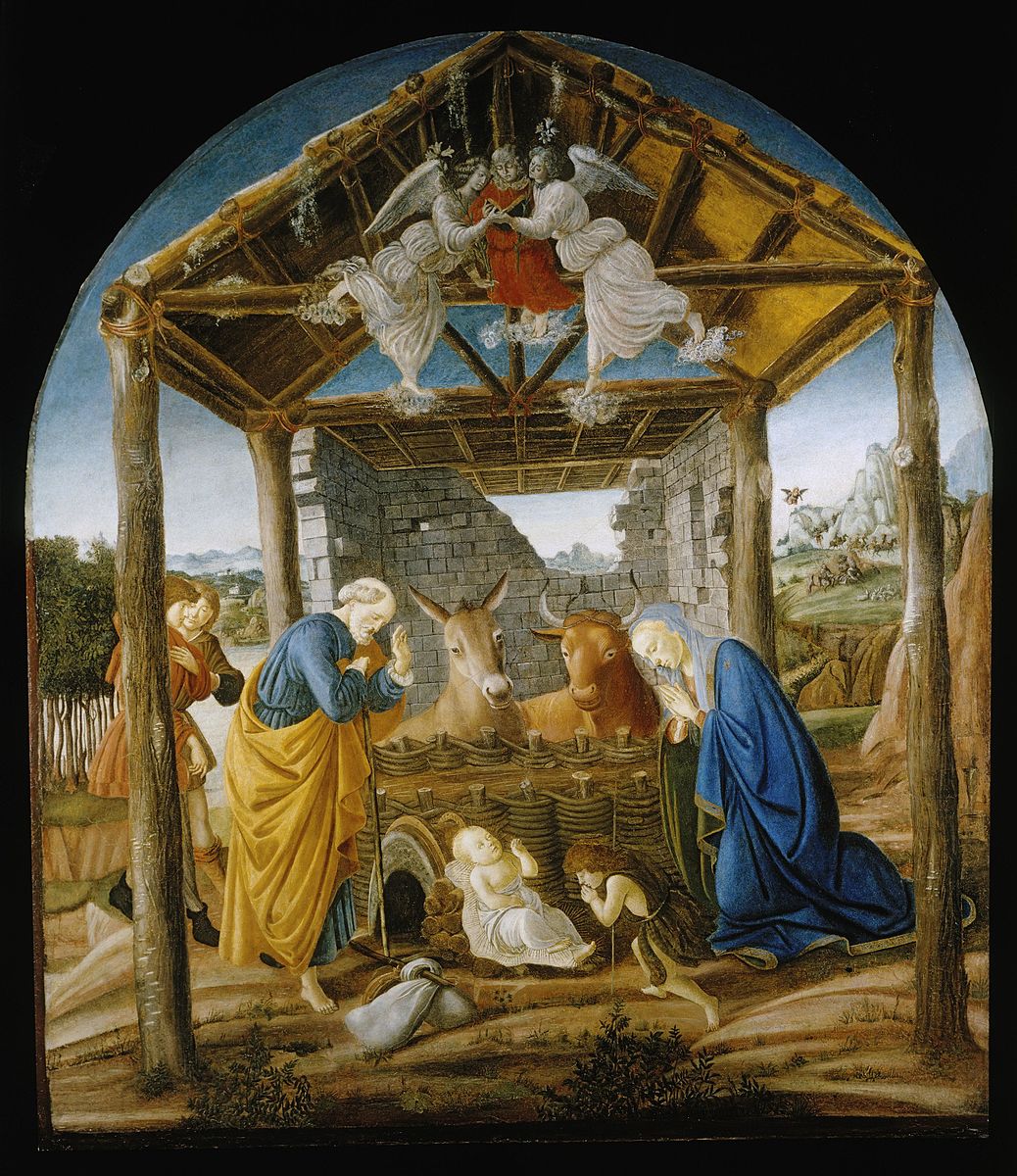
The Nativity of the Lord
Holy Day of Obligation
Merry Christmas!
Liturgical Color: White
Rosary Mysteries: Luminous Mysteries

Daily Readings
First Reading: Isaiah 62: 1-5
1 For Sion’s sake I will not hold my peace, and for the sake of Jerusalem, I will not rest till her just one come forth as brightness, and her saviour be lighted as a lamp.
2 And the Gentiles shall see thy just one, and all kings thy glorious one: and thou shalt be called by a new name, which the mouth of the Lord shall name.
3 And thou shalt be a crown of glory in the hand of the Lord, and a royal diadem in the hand of thy God.
4 Thou shalt no more be called Forsaken: and thy land shall no more be called Desolate: but thou shalt be called My pleasure in her, and thy land inhabited. Because the Lord hath been well pleased with thee: and thy land shall be inhabited.
5 For the young man shall dwell with the virgin, and thy children shall dwell in thee. And the bridegroom shall rejoice over the bride, and thy God shall rejoice over thee.
1 [Propter Sion non tacebo,
et propter Jerusalem non quiescam,
donec egrediatur ut splendor justus ejus,
et salvator ejus ut lampas accendatur.
2 Et videbunt gentes justum tuum,
et cuncti reges inclytum tuum;
et vocabitur tibi nomen novum,
quod os Domini nominabit.
3 Et eris corona gloriæ in manu Domini,
et diadema regni in manu Dei tui.
4 Non vocaberis ultra Derelicta,
et terra tua non vocabitur amplius Desolata;
sed vocaberis, Voluntas mea in ea,
et terra tua Inhabitata,
quia complacuit Domino in te,
et terra tua inhabitabitur.
5 Habitabit enim juvenis cum virgine,
et habitabunt in te filii tui;
et gaudebit sponsus super sponsam,
et gaudebit super te Deus tuus.
Second Reading: Acts 13: 16-17, 22-25
16 Then Paul rising up, and with his hand bespeaking silence, said: Ye men of Israel, and you that fear God, give ear.
17 The God of the people of Israel chose our fathers, and exalted the people when they were sojourners in the land of Egypt, and with an high arm brought them out from thence,
22 And when he had removed him, he raised them up David to be king: to whom giving testimony, he said: I have found David, the son of Jesse, a man according to my own heart, who shall do all my wills.
23 Of this man’s seed God according to his promise, hath raised up to Israel a Saviour, Jesus:
24 John first preaching, before his coming, the baptism of penance to all the people of Israel.
25 And when John was fulfilling his course, he said: I am not he, whom you think me to be: but behold, there cometh one after me, whose shoes of his feet I am not worthy to loose.
16 Surgens autem Paulus, et manu silentium indicens, ait: Viri Israëlitæ, et qui timetis Deum, audite:
17 Deus plebis Israël elegit patres nostros, et plebem exaltavit cum essent incolæ in terra Ægypti, et in brachio excelso eduxit eos ex ea,
22 et amoto illo, suscitavit illis David regem: cui testimonium perhibens, dixit: Inveni David filium Jesse, virum secundum cor meum, qui faciet omnes voluntates meas.
23 Hujus Deus ex semine secundum promissionem eduxit Israël salvatorem Jesum,
24 prædicante Joanne ante faciem adventus ejus baptismum pœnitentiæ omni populo Israël.
25 Cum impleret autem Joannes cursum suum, dicebat: Quem me arbitramini esse, non sum ego: sed ecce venit post me, cujus non sum dignus calceamenta pedum solvere.
Gospel: Matthew 1: 1-25
1 The book of the generation of Jesus Christ, the son of David, the son of Abraham:
2 Abraham begot Isaac. And Isaac begot Jacob. And Jacob begot Judas and his brethren.
3 And Judas begot Phares and Zara of Thamar. And Phares begot Esron. And Esron begot Aram.
4 And Aram begot Aminadab. And Aminadab begot Naasson. And Naasson begot Salmon.
5 And Salmon begot Booz of Rahab. And Booz begot Obed of Ruth. And Obed begot Jesse.
6 And Jesse begot David the king. And David the king begot Solomon, of her that had been the wife of Urias.
7 And Solomon begot Roboam. And Roboam begot Abia. And Abia begot Asa.
8 And Asa begot Josaphat. And Josaphat begot Joram. And Joram begot Ozias.
9 And Ozias begot Joatham. And Joatham begot Achaz. And Achaz begot Ezechias.
10 And Ezechias begot Manasses. And Manasses begot Amon. And Amon begot Josias.
11 And Josias begot Jechonias and his brethren in the transmigration of Babylon.
12 And after the transmigration of Babylon, Jechonias begot Salathiel. And Salathiel begot Zorobabel.
13 And Zorobabel begot Abiud. And Abiud begot Eliacim. And Eliacim begot Azor.
14 And Azor begot Sadoc. And Sadoc begot Achim. And Achim begot Eliud.
15 And Eliud begot Eleazar. And Eleazar begot Mathan. And Mathan begot Jacob.
16 And Jacob begot Joseph the husband of Mary, of whom was born Jesus, who is called Christ.
17 So all the generations, from Abraham to David, are fourteen generations. And from David to the transmigration of Babylon, are fourteen generations: and from the transmigration of Babylon to Christ are fourteen generations.
18 Now the generation of Christ was in this wise. When as his mother Mary was espoused to Joseph, before they came together, she was found with child, of the Holy Ghost.
19 Whereupon Joseph her husband, being a just man, and not willing publicly to expose her, was minded to put her away privately.
20 But while he thought on these things, behold the angel of the Lord appeared to him in his sleep, saying: Joseph, son of David, fear not to take unto thee Mary thy wife, for that which is conceived in her, is of the Holy Ghost.
21 And she shall bring forth a son: and thou shalt call his name JESUS. For he shall save his people from their sins.
22 Now all this was done that it might be fulfilled which the Lord spoke by the prophet, saying:
23 Behold a virgin shall be with child, and bring forth a son, and they shall call his name Emmanuel, which being interpreted is, God with us.
24 And Joseph rising up from sleep, did as the angel of the Lord had commanded him, and took unto him his wife.
25 And he knew her not till she brought forth her firstborn son: and he called his name JESUS.
1 Liber generationis Jesu Christi filii David, filii Abraham.
2 Abraham genuit Isaac. Isaac autem genuit Jacob. Jacob autem genuit Judam, et fratres ejus.
3 Judas autem genuit Phares, et Zaram de Thamar. Phares autem genuit Esron. Esron autem genuit Aram.
4 Aram autem genuit Aminadab. Aminadab autem genuit Naasson. Naasson autem genuit Salmon.
5 Salmon autem genuit Booz de Rahab. Booz autem genuit Obed ex Ruth. Obed autem genuit Jesse. Jesse autem genuit David regem.
6 David autem rex genuit Salomonem ex ea quæ fuit Uriæ.
7 Salomon autem genuit Roboam. Roboam autem genuit Abiam. Abias autem genuit Asa.
8 Asa autem genuit Josophat. Josophat autem genuit Joram. Joram autem genuit Oziam.
9 Ozias autem genuit Joatham. Joatham autem genuit Achaz. Achaz autem genuit Ezechiam.
10 Ezechias autem genuit Manassen. Manasses autem genuit Amon. Amon autem genuit Josiam.
11 Josias autem genuit Jechoniam, et fratres ejus in transmigratione Babylonis.
12 Et post transmigrationem Babylonis: Jechonias genuit Salathiel. Salathiel autem genuit Zorobabel.
13 Zorobabel autem genuit Abiud. Abiud autem genuit Eliacim. Eliacim autem genuit Azor.
14 Azor autem genuit Sadoc. Sadoc autem genuit Achim. Achim autem genuit Eliud.
15 Eliud autem genuit Eleazar. Eleazar autem genuit Mathan. Mathan autem genuit Jacob.
16 Jacob autem genuit Joseph virum Mariæ, de qua natus est Jesus, qui vocatur Christus.
17 Omnes itaque generationes ab Abraham usque ad David, generationes quatuordecim: et a David usque ad transmigrationem Babylonis, generationes quatuordecim: et a transmigratione Babylonis usque ad Christum, generationes quatuordecim.
18 Christi autem generatio sic erat: cum esset desponsata mater ejus Maria Joseph, antequam convenirent inventa est in utero habens de Spiritu Sancto.
19 Joseph autem vir ejus cum esset justus, et nollet eam traducere, voluit occulte dimittere eam.
20 Hæc autem eo cogitante, ecce angelus Domini apparuit in somnis ei, dicens: Joseph, fili David, noli timere accipere Mariam conjugem tuam: quod enim in ea natum est, de Spiritu Sancto est.
21 Pariet autem filium: et vocabis nomen ejus Jesum: ipse enim salvum faciet populum suum a peccatis eorum.
22 Hoc autem totum factum est, ut adimpleretur quod dictum est a Domino per prophetam dicentem:
23 Ecce virgo in utero habebit, et pariet filium: et vocabunt nomen ejus Emmanuel, quod est interpretatum Nobiscum Deus.
24 Exsurgens autem Joseph a somno, fecit sicut præcepit ei angelus Domini, et accepit conjugem suam.
25 Et non cognoscebat eam donec peperit filium suum primogenitum: et vocavit nomen ejus Jesum.

A Daily Question from the Summa Theologica
Whether there are two filiations in Christ?(Article 5 of 8 of Question 35. Of Christ’s Nativity from the Treatise on the Incarnation)
Objection 1: It would seem that there are two filiations in Christ. For nativity is the cause of filiation. But in Christ there are two nativities. Therefore in Christ there are also two filiations.
Objection 2: Further, filiation, which is said of a man as being the son of someone, his father or his mother, depends, in a way, on him: because the very being of a relation consists “in being referred to another”; wherefore if one of two relatives be destroyed, the other is destroyed also. But the eternal filiation by which Christ is the Son of God the Father depends not on His Mother, because nothing eternal depends on what is temporal. Therefore Christ is not His Mother’s Son by temporal filiation. Either, therefore, He is not her Son at all, which is in contradiction to what has been said above (AA[3],4), or He must needs be her Son by some other temporal filiation. Therefore in Christ there are two filiations.
Objection 3: Further, one of two relatives enters the definition of the other; hence it is clear that of two relatives, one is specified from the other. But one and the same cannot be in diverse species. Therefore it seems impossible that one and the same relation be referred to extremes which are altogether diverse. But Christ is said to be the Son of the Eternal Father and a temporal mother, who are terms altogether diverse. Therefore it seems that Christ cannot, by the same relation, be called the Son of the Father and of His Mother Therefore in Christ there are two filiations.
On the contrary, As Damascene says (De Fide Orth. iii), things pertaining to the nature are multiple in Christ; but not those things that pertain to the Person. But filiation belongs especially to the Person, since it is a personal property, as appears from what was said in the FP, Q[32], A[3]; FP, Q[40], A[2]. Therefore there is but one filiation in Christ.
I answer that, opinions differ on this question. For some, considering only the cause of filiation, which is nativity, put two filiations in Christ, just as there are two nativities. On the contrary, others, considering only the subject of filiation, which is the person or hypostasis, put only one filiation in Christ, just as there is but one hypostasis or person. Because the unity or plurality of a relation is considered in respect, not of its terms, but of its cause or of its subject. For if it were considered in respect of its terms, every man would of necessity have in himself two filiations—one in reference to his father, and another in reference to his mother. But if we consider the question aright, we shall see that every man bears but one relation to both his father and his mother, on account of the unity of the cause thereof. For man is born by one birth of both father and mother: whence he bears but one relation to both. The same is said of one master who teaches many disciples the same doctrine, and of one lord who governs many subjects by the same power. But if there be various causes specifically diverse, it seems that in consequence the relations differ in species: wherefore nothing hinders several such relations being in the same subject. Thus if a man teach grammar to some and logic to others, his teaching is of a different kind in one case and in the other; and therefore one and the same man may have different relations as the master of different disciples, or of the same disciples in regard to diverse doctrines. Sometimes, however, it happens that a man bears a relation to several in respect of various causes, but of the same species: thus a father may have several sons by several acts of generation. Wherefore the paternity cannot differ specifically, since the acts of generation are specifically the same. And because several forms of the same species cannot at the same time be in the same subject, it is impossible for several paternities to be in a man who is the father of several sons by natural generation. But it would not be so were he the father of one son by natural generation and of another by adoption.
Now, it is manifest that Christ was not born by one and the same nativity, of the Father from eternity, and of His Mother in time: indeed, these two nativities differ specifically. Wherefore, as to this, we must say that there are various filiations, one temporal and the other eternal. Since, however, the subject of filiation is neither the nature nor part of the nature, but the person or hypostasis alone; and since in Christ there is no other hypostasis or person than the eternal, there can be no other filiation in Christ but that which is in the eternal hypostasis. Now, every relation which is predicated of God from time does not put something real in the eternal God, but only something according to our way of thinking, as we have said in the FP, Q[13], A[7]. Therefore the filiation by which Christ is referred to His Mother cannot be a real relation, but only a relation of reason.
Consequently each opinion is true to a certain extent. For if we consider the adequate causes of filiation, we must needs say that there are two filiations in respect of the twofold nativity. But if we consider the subject of filiation, which can only be the eternal suppositum, then no other than the eternal filiation in Christ is a real relation. Nevertheless, He has the relation of Son in regard to His Mother, because it is implied in the relation of motherhood to Christ. Thus God is called Lord by a relation which is implied in the real relation by which the creature is subject to God. And although lordship is not a real relation in God, yet is He really Lord through the real subjection of the creature to Him. In the same way Christ is really the Son of the Virgin Mother through the real relation of her motherhood to Christ.
Reply to Objection 1: Temporal nativity would cause a real temporal filiation in Christ if there were in Him a subject capable of such filiation. But this cannot be; since the eternal suppositum cannot be receptive of a temporal relation, as stated above. Nor can it be said that it is receptive of temporal filiation by reason of the human nature, just as it is receptive of the temporal nativity; because human nature would need in some way to be the subject of filiation, just as in a way it is the subject of nativity; for since an Ethiopian is said to be white by reason of his teeth, it must be that his teeth are the subject of whiteness. But human nature can nowise be the subject of filiation, because this relation regards directly the person.
Reply to Objection 2: Eternal filiation does not depend on a temporal mother, but together with this eternal filiation we understand a certain temporal relation dependent on the mother, in respect of which relation Christ is called the Son of His Mother.
Reply to Objection 3: One and being are mutually consequent, as is said Metaph. iv. Therefore, just as it happens that in one of the extremes of a relation there is something real, whereas in the other there is not something real, but merely a certain aspect, as the Philosopher observes of knowledge and the thing known; so also it happens that on the part of one extreme there is one relation, whereas on the part of the other there are many. Thus in man on the part of his parents there is a twofold relation, the one of paternity, the other of motherhood, which are specifically diverse, inasmuch as the father is the principle of generation in one way, and the mother in another (whereas if many be the principle of one action and in the same way—for instance, if many. together draw a ship along—there would be one and the same relation in all of them); but on the part of the child there is but one filiation in reality, though there be two in aspect, corresponding to the two relations in the parents, as considered by the intellect. And thus in one way there is only one real filiation in Christ, which is in respect of the Eternal Father: yet there is another temporal relation in regard to His temporal mother.
Continue reading the rest of the articles on Sacred Texts Archive website.