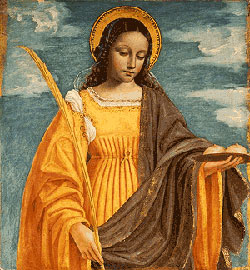
Memorial of Saint Agatha, Virgin and Martyr
Liturgical Color: Red
Rosary Mysteries: Luminous Mysteries
“Lord Jesus Christ, good Master, I give You thanks that You granted me victory over the executioners’ tortures. Grant now that I may happily dwell in Your never-ending glory.”
Saint Agatha
est. 231 or 235 – February 5, 251
Patron of breast cancer patients, rape victims, wet nurses, and martyrs

Daily Readings
First Reading: 1 Kings 2: 1-4, 10-12
1 And the days of David drew nigh that he should die, and he charged his son Solomon, saying:
2 I am going the way of all flesh: take thou courage, and shew thyself a man.
3 And keep the charge of the Lord thy God, to walk in his ways, and observe his ceremonies, and his precepts, and judgments, and testimonies, as it is written in the law of Moses: that thou mayest understand all thou dost, and whithersoever thou shalt turn thyself:
4 That the Lord may confirm his words, which he hath spoken of me, saying: If thy children shall take heed to their ways, and shall walk before me in truth, with all their heart, and with all their soul, there shall not be taken away from thee a man on the throne of Israel.
10 So David slept with his fathers, and was buried in the city of David.
11 And the days that David reigned in Israel, were forty years: in Hebron he reigned seven years, in Jerusalem thirty-three.
12 And Solomon sat upon the throne of his father David, and his kingdom was strengthened exceedingly.
1 Appropinquaverunt autem dies David ut moreretur: præcepitque Salomoni filio suo, dicens:
2 Ego ingredior viam universæ terræ: confortare, et esto vir.
3 Et observa custodias Domini Dei tui, ut ambules in viis ejus: ut custodias cæremonias ejus, et præcepta ejus, et judicia, et testimonia, sicut scriptum est in lege Moysi: ut intelligas universa quæ facis, et quocumque te verteris:
4 ut confirmet Dominus sermones suos quos locutus est de me, dicens: Si custodierint filii tui vias suas, et ambulaverint coram me in veritate, in omni corde suo et in omni anima sua, non auferetur tibi vir de solio Israël.
10 Dormivit igitur David cum patribus suis, et sepultus est in civitate David.
11 Dies autem quibus regnavit David super Israël, quadraginta anni sunt: in Hebron regnavit septem annis; in Jerusalem, triginta tribus.
12 Salomon autem sedit super thronum David patris sui, et firmatum est regnum ejus nimis.
Gospel: Mark 6: 7-13
7 And he called the twelve; and began to send them two and two, and gave them power over unclean spirits.
8 And he commanded them that they should take nothing for the way, but a staff only: no scrip, no bread, nor money in their purse,
9 But to be shod with sandals, and that they should not put on two coats.
10 And he said to them: Wheresoever you shall enter into an house, there abide till you depart from that place.
11 And whosoever shall not receive you, nor hear you; going forth from thence, shake off the dust from your feet for a testimony to them.
12 And going forth they preached that men should do penance:
13 And they cast out many devils, and anointed with oil many that were sick, and healed them.
7 Et vocavit duodecim: et cœpit eos mittere binos, et dabat illis potestatem spirituum immundorum.
8 Et præcepit eis ne quid tollerent in via, nisi virgam tantum: non peram, non panem, neque in zona æs,
9 sed calceatos sandaliis, et ne induerentur duabus tunicis.
10 Et dicebat eis: Quocumque introieritis in domum, illic manete donec exeatis inde:
11 et quicumque non receperint vos, nec audierint vos, exeuntes inde, excutite pulverem de pedibus vestris in testimonium illis.
12 Et exeuntes prædicabant ut pœnitentiam agerent:
13 et dæmonia multa ejiciebant, et ungebant oleo multos ægros, et sanabant.

A Daily Question from the Summa Theologica
Whether a character is a spiritual power? (Article 2 of 6 of Question 63. Of the Other Effect of the Sacrament Which is a Character from the Treatise on the Sacraments)
Objection 1: It seems that a character is not a spiritual power. For “character” seems to be the same thing as “figure”; hence (Heb. 1:3), where we read “figure of His substance, “for “figure” the Greek has . Now “figure” is in the fourth species of quality, and thus differs from power which is in the second species. Therefore character is not a spiritual power.
Objection 2: Further, Dionysius says (Eccl. Hier. ii): “The Divine Beatitude admits him that seeks happiness to a share in Itself, and grants this share to him by conferring on him Its light as a kind of seal.” Consequently, it seems that a character is a kind of light. Now light belongs rather to the third species of quality. Therefore a character is not a power, since this seems to belong to the second species.
Objection 3: Further, character is defined by some thus: “A character is a holy sign of the communion of faith and of the holy ordination conferred by a hierarch.” Now a sign is in the genus of “relation,” not of “power.” Therefore a character is not a spiritual power.
Objection 4: Further, a power is in the nature of a cause and principle (Metaph. v). But a “sign” which is set down in the definition of a character is rather in the nature of an effect. Therefore a character is not a spiritual power.
On the contrary, The Philosopher says (Ethic. ii): “There are three things in the soul, power, habit, and passion.” Now a character is not a passion: since a passion passes quickly, whereas a character is indelible, as will be made clear further on (A[5]). In like manner it is not a habit: because no habit is indifferent to acting well or ill: whereas a character is indifferent to either, since some use it well, some ill. Now this cannot occur with a habit: because no one abuses a habit of virtue, or uses well an evil habit. It remains, therefore, that a character is a power.
I answer that, As stated above (A[1]), the sacraments of the New Law produce a character, in so far as by them we are deputed to the worship of God according to the rite of the Christian religion. Wherefore Dionysius (Eccl. Hier. ii), after saying that God “by a kind of sign grants a share of Himself to those that approach Him,” adds “by making them Godlike and communicators of Divine gifts.” Now the worship of God consists either in receiving Divine gifts, or in bestowing them on others. And for both these purposes some power is needed; for to bestow something on others, active power is necessary; and in order to receive, we need a passive power. Consequently, a character signifies a certain spiritual power ordained unto things pertaining to the Divine worship.
But it must be observed that this spiritual power is instrumental: as we have stated above (Q[62], A[4]) of the virtue which is in the sacraments. For to have a sacramental character belongs to God’s ministers: and a minister is a kind of instrument, as the Philosopher says (Polit. i). Consequently, just as the virtue which is in the sacraments is not of itself in a genus, but is reducible to a genus, for the reason that it is of a transitory and incomplete nature: so also a character is not properly in a genus or species, but is reducible to the second species of quality.
Reply to Objection 1: Configuration is a certain boundary of quantity. Wherefore, properly speaking, it is only in corporeal things; and of spiritual things is said metaphorically. Now that which decides the genus or species of a thing must needs be predicated of it properly. Consequently, a character cannot be in the fourth species of quality, although some have held this to be the case.
Reply to Objection 2: The third species of quality contains only sensible passions or sensible qualities. Now a character is not a sensible light. Consequently, it is not in the third species of quality as some have maintained.
Reply to Objection 3: The relation signified by the word “sign” must needs have some foundation. Now the relation signified by this sign which is a character, cannot be founded immediately on the essence of the soul: because then it would belong to every soul naturally. Consequently, there must be something in the soul on which such a relation is founded. And it is in this that a character essentially consists. Therefore it need not be in the genus “relation” as some have held.
Reply to Objection 4: A character is in the nature of a sign in comparison to the sensible sacrament by which it is imprinted. But considered in itself, it is in the nature of a principle, in the way already explained.
Continue reading the rest of the articles on Sacred Texts Archive website.