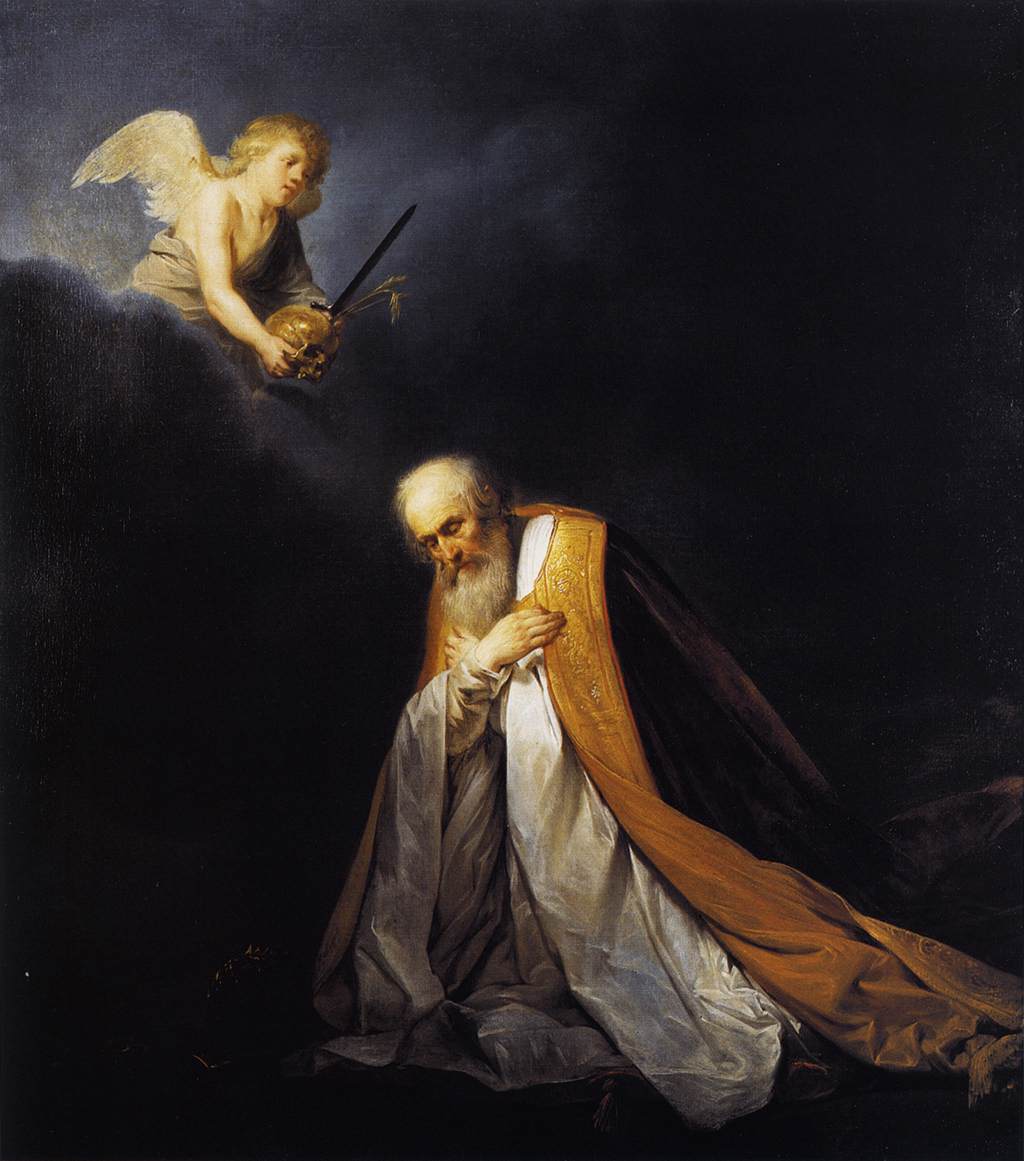
Weekday
Liturgical Color: Green
Rosary Mysteries: Luminous Mysteries

Daily Readings
First Reading: 2 Samuel 7: 18-19, 24-29
18 And David went in, and sat before the Lord, and said: Who am I, O Lord God, and what is my house, that thou hast brought me thus far?
19 But yet this hath seemed little in thy sight, O Lord God, unless thou didst also speak of the house of thy servant for a long time to come: for this is the law of Adam, O Lord God.
24 For thou hast confirmed to thyself thy people Israel to be an everlasting people: and thou, O Lord God, art become their God.
25 And now, O Lord God, raise up for ever the word that thou hast spoken, concerning thy servant and concerning his house: and do as thou hast spoken,
26 That thy name may be magnified for ever, and it may be said: The Lord of hosts is God over Israel. And the house of thy servant David shall be established before the Lord.
27 Because thou, O Lord of hosts, God of Israel, hast revealed to the ear of thy servant, saying: I will build thee a house: therefore hath thy servant found in his heart to pray this prayer to thee.
28 And now, O Lord God, thou art God, and thy words shall be true: for thou hast spoken to thy servant these good things.
29 And now begin, and bless the house of thy servant, that it may endure for ever before thee: because thou, O Lord God, hast spoken it, and with thy blessing let the house of thy servant be blessed for ever.
18 Ingressus est autem rex David, et sedit coram Domino, et dixit: Quis ego sum, Domine Deus, et quæ domus mea, quia adduxisti me hucusque?
19 Sed et hoc parum visum est in conspectu tuo, Domine Deus, nisi loquereris etiam de domo servi tui in longinquum: ista est enim lex Adam, Domine Deus.
24 Firmasti enim tibi populum tuum Israël in populum sempiternum: et tu, Domine Deus, factus es eis in Deum.
25 Nunc ergo Domine Deus, verbum quod locutus es super servum tuum, et super domum ejus, suscita in sempiternum: et fac sicut locutus es,
26 ut magnificetur nomen tuum usque in sempiternum, atque dicatur: Dominus exercituum, Deus super Israël. Et domus servi tui David erit stabilita coram Domino,
27 quia tu, Domine exercituum Deus Israël, revelasti aurem servi tui, dicens: Domum ædificabo tibi: propterea invenit servus tuus cor suum ut oraret te oratione hac.
28 Nunc ergo Domine Deus, tu es Deus, et verba tua erunt vera: locutus es enim ad servum tuum bona hæc.
29 Incipe ergo, et benedic domui servi tui, ut sit in sempiternum coram te: quia tu, Domine Deus, locutus es, et benedictione tua benedicetur domus servi tui in sempiternum.
Gospel: Mark 4: 21-25
21 And he said to them: Doth a candle come in to be put under a bushel, or under a bed? and not to be set on a candlestick?
22 For there is nothing hid, which shall not be made manifest: neither was it made secret, but that it may come abroad.
23 If any man have ears to hear, let him hear.
24 And he said to them: Take heed what you hear. In what measure you shall mete, it shall be measured to you again, and more shall be given to you.
25 For he that hath, to him shall be given: and he that hath not, that also which he hath shall be taken away from him.
21 Et dicebat illis: Numquid venit lucerna ut sub modo ponatur, aut sub lecto? nonne ut super candelabrum ponatur?
22 Non est enim aliquid absconditum, quod non manifestetur: nec factum est occultum, sed ut in palam veniat.
23 Si quis habet aures audiendi, audiat.
24 Et dicebat illis: Videte quid audiatis. In qua mensura mensi fueritis, remetietur vobis, et adjicietur vobis.
25 Qui enim habet, dabitur illi: et qui non habet, etiam quod habet auferetur ab eo.

A Daily Question from the Summa Theologica
Whether the sacraments are the cause of grace? (Article 1 of 6 of Question 62. Of the Sacraments’ Principal Effect Which is Grace from the Treatise on the Sacraments)
Objection 1: It seems that the sacraments are not the cause of grace. For it seems that the same thing is not both sign and cause: since the nature of sign appears to be more in keeping with an effect. But a sacrament is a sign of grace. Therefore it is not its cause.
Objection 2: Further, nothing corporeal can act on a spiritual thing: since “the agent is more excellent than the patient,” as Augustine says (Gen. ad lit. xii). But the subject of grace is the human mind, which is something spiritual. Therefore the sacraments cannot cause grace.
Objection 3: Further, what is proper to God should not be ascribed to a creature. But it is proper to God to cause grace, according to Ps. 83:12: “The Lord will give grace and glory.” Since, therefore, the sacraments consist in certain words and created things, it seems that they cannot cause grace.
On the contrary, Augustine says (Tract. lxxx in Joan.) that the baptismal water “touches the body and cleanses the heart.” But the heart is not cleansed save through grace. Therefore it causes grace: and for like reason so do the other sacraments of the Church.
I answer that, We must needs say that in some way the sacraments of the New Law cause grace. For it is evident that through the sacraments of the New Law man is incorporated with Christ: thus the Apostle says of Baptism (Gal. 3:27): “As many of you as have been baptized in Christ have put on Christ.” And man is made a member of Christ through grace alone.
Some, however, say that they are the cause of grace not by their own operation, but in so far as God causes grace in the soul when the sacraments are employed. And they give as an example a man who on presenting a leaden coin, receives, by the king’s command, a hundred pounds: not as though the leaden coin, by any operation of its own, caused him to be given that sum of money; this being the effect of the mere will of the king. Hence Bernard says in a sermon on the Lord’s Supper: “Just as a canon is invested by means of a book, an abbot by means of a crozier, a bishop by means of a ring, so by the various sacraments various kinds of grace are conferred.” But if we examine the question properly, we shall see that according to the above mode the sacraments are mere signs. For the leaden coin is nothing but a sign of the king’s command that this man should receive money. In like manner the book is a sign of the conferring of a canonry. Hence, according to this opinion the sacraments of the New Law would be mere signs of grace; whereas we have it on the authority of many saints that the sacraments of the New Law not only signify, but also cause grace.
We must therefore say otherwise, that an efficient cause is twofold, principal and instrumental. The principal cause works by the power of its form, to which form the effect is likened; just as fire by its own heat makes something hot. In this way none but God can cause grace: since grace is nothing else than a participated likeness of the Divine Nature, according to 2 Pet. 1:4: “He hath given us most great and precious promises; that we may be [Vulg.: ‘you may be made’] partakers of the Divine Nature.” But the instrumental cause works not by the power of its form, but only by the motion whereby it is moved by the principal agent: so that the effect is not likened to the instrument but to the principal agent: for instance, the couch is not like the axe, but like the art which is in the craftsman’s mind. And it is thus that the sacraments of the New Law cause grace: for they are instituted by God to be employed for the purpose of conferring grace. Hence Augustine says (Contra Faust. xix): “All these things,” viz. pertaining to the sacraments, “are done and pass away, but the power,” viz. of God, “which works by them, remains ever.” Now that is, properly speaking, an instrument by which someone works: wherefore it is written (Titus 3:5): “He saved us by the laver of regeneration.”
Reply to Objection 1: The principal cause cannot properly be called a sign of its effect, even though the latter be hidden and the cause itself sensible and manifest. But an instrumental cause, if manifest, can be called a sign of a hidden effect, for this reason, that it is not merely a cause but also in a measure an effect in so far as it is moved by the principal agent. And in this sense the sacraments of the New Law are both cause and signs. Hence, too, is it that, to use the common expression, “they effect what they signify.” From this it is clear that they perfectly fulfil the conditions of a sacrament; being ordained to something sacred, not only as a sign, but also as a cause.
Reply to Objection 2: An instrument has a twofold action; one is instrumental, in respect of which it works not by its own power but by the power of the principal agent: the other is its proper action, which belongs to it in respect of its proper form: thus it belongs to an axe to cut asunder by reason of its sharpness, but to make a couch, in so far as it is the instrument of an art. But it does not accomplish the instrumental action save by exercising its proper action: for it is by cutting that it makes a couch. In like manner the corporeal sacraments by their operation, which they exercise on the body that they touch, accomplish through the Divine institution an instrumental operation on the soul; for example, the water of baptism, in respect of its proper power, cleanses the body, and thereby, inasmuch as it is the instrument of the Divine power, cleanses the soul: since from soul and body one thing is made. And thus it is that Augustine says (Gen. ad lit. xii) that it “touches the body and cleanses the heart.”
Reply to Objection 3: This argument considers that which causes grace as principal agent; for this belongs to God alone, as stated above.
Continue reading the rest of the articles on Sacred Texts Archive website.