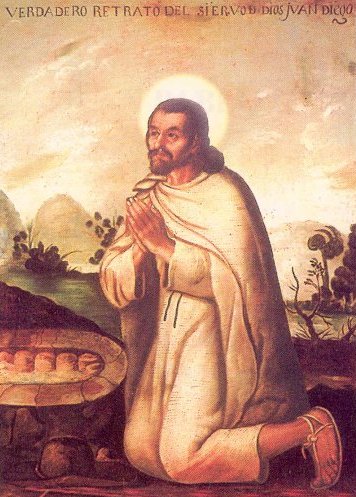
Optional Memorial of Saint Juan Diego Cuauhtlatoatzin
Liturgical Color: Violet or White
Rosary Mysteries: Sorrowful Mysteries
“I am a nobody, I am a small rope, a tiny ladder, the tail end, a leaf.”
Saint Juan Diego
1474 – May 30, 1548
Patron of all Indigenous peoples in the Americas

Daily Readings
First Reading: Isaiah 40:1-11
Promise of Salvation
1 Comfort, give comfort to my people,
says your God.
2 Speak to the heart of Jerusalem, and proclaim to her
that her service has ended,
that her guilt is expiated,
That she has received from the hand of the LORD
double for all her sins.
3 A voice proclaims:
In the wilderness prepare the way of the LORD!
Make straight in the wasteland a highway for our God!
4 Every valley shall be lifted up,
every mountain and hill made low;
The rugged land shall be a plain,
the rough country, a broad valley.
5 Then the glory of the LORD shall be revealed,
and all flesh shall see it together;
for the mouth of the LORD has spoken.
6 A voice says, “Proclaim!”
I answer, “What shall I proclaim?”
“All flesh is grass,
and all their loyalty like the flower of the field.
7 The grass withers, the flower wilts,
when the breath of the LORD blows upon it.”
“Yes, the people is grass!
8 The grass withers, the flower wilts,
but the word of our God stands forever.”
9 Go up onto a high mountain,
Zion, herald of good news!
Cry out at the top of your voice,
Jerusalem, herald of good news!
Cry out, do not fear!
Say to the cities of Judah:
Here is your God!
10 Here comes with power
the Lord GOD,
who rules by his strong arm;
Here is his reward with him,
his recompense before him.
11 Like a shepherd he feeds his flock;
in his arms he gathers the lambs,
Carrying them in his bosom,
leading the ewes with care.
1 [Consolamini, consolamini, popule meus,
dicit Deus vester.
2 Loquimini ad cor Jerusalem,
et advocate eam,
quoniam completa est malitia ejus,
dimissa est iniquitas illius:
suscepit de manu Domini duplicia
pro omnibus peccatis suis.
3 Vox clamantis in deserto:
Parate viam Domini,
rectas facite in solitudine semitas Dei nostri.
4 Omnis vallis exaltabitur,
et omnis mons et collis humiliabitur,
et erunt prava in directa,
et aspera in vias planas:
5 et revelabitur gloria Domini,
et videbit omnis caro pariter
quod os Domini locutum est.
6 Vox dicentis: Clama.
Et dixi: Quid clamabo?
Omnis caro fœnum,
et omnis gloria ejus quasi flos agri.
7 Exsiccatum est fœnum, et cecidit flos,
quia spiritus Domini sufflavit in eo.
Vere fœnum est populus:
8 exsiccatum est fœnum, et cecidit flos;
verbum autem Domini nostri manet in æternum.
9 Super montem excelsum ascende,
tu qui evangelizas Sion;
exalta in fortitudine vocem tuam,
qui evangelizas Jerusalem:
exalta, noli timere.
Dic civitatibus Juda:
Ecce Deus vester:
10 ecce Dominus Deus in fortitudine veniet,
et brachium ejus dominabitur:
ecce merces ejus cum eo,
et opus illius coram illo.
11 Sicut pastor gregem suum pascet,
in brachio suo congregabit agnos,
et in sinu suo levabit;
fœtas ipse portabit.
Gospel: Matthew 18:12-14
12 What is your opinion? If a man has a hundred sheep and one of them goes astray, will he not leave the ninety-nine in the hills and go in search of the stray?
13 And if he finds it, amen, I say to you, he rejoices more over it than over the ninety-nine that did not stray.
14 In just the same way, it is not the will of your heavenly Father that one of these little ones be lost.
12 Quid vobis videtur? si fuerint alicui centum oves, et erravit una ex eis: nonne relinquit nonaginta novem in montibus, et vadit quærere eam quæ erravit?
13 Et si contigerit ut inveniat eam: amen dico vobis, quia gaudet super eam magis quam super nonaginta novem, quæ non erraverunt.
14 Sic non est voluntas ante Patrem vestrum, qui in cælis est, ut pereat unus de pusillis istis.

A Daily Question from the Summa Theologica
Whether the Blessed Virgin was cleansed from the infection of the fomes? (Article 3 of 6 of Question 27. Of the Sanctification of the Blessed Virgin from the Treatise on the Incarnation)
Objection 1: It would seem that the Blessed Virgin was not cleansed from the infection of the fomes. For just as the fomes, consisting in the rebellion of the lower powers against the reason, is a punishment of original sin; so also are death and other corporeal penalties. Therefore the fomes was not entirely removed from her.
Objection 2: Further, it is written (2 Cor. 12:9): “Power is made perfect in infirmity,” which refers to the weakness of the fomes, by reason of which he (the Apostle) felt the “sting of the flesh.” But it was not fitting that anything should be taken away from the Blessed Virgin, pertaining to the perfection of virtue. Therefore it was unfitting that the fomes should be entirely taken away from her.
Objection 3: Further, Damascene says (De Fide Orth. iii) that “the Holy Ghost came upon” the Blessed Virgin, “purifying her,” before she conceived the Son of God. But this can only be understood of purification from the fomes: for she committed no sin, as Augustine says (De Nat. et Grat. xxvi). Therefore by the sanctification in the womb she was not absolutely cleansed from the fomes.
On the contrary, It is written (Canticles 4:7): “Thou art all fair, O my love, and there is not a spot in thee!” But the fomes implies a blemish, at any rate in the flesh. Therefore the fomes was not in the Blessed Virgin.
I answer that, on this point there are various opinions. For some have held that the fomes was entirely taken away in that sanctification whereby the Blessed Virgin was sanctified in the womb. Others say that it remained as far as it causes a difficulty in doing good, but was taken away as far as it causes a proneness to evil. Others again, that it was taken away as to the personal corruption, by which it makes us quick to do evil and slow to do good: but that it remained as to the corruption of nature, inasmuch as it is the cause of transmitting original sin to the offspring. Lastly, others say that, in her first sanctification, the fomes remained essentially, but was fettered; and that, when she conceived the Son of God, it was entirely taken away. In order to understand the question at issue, it must be observed that the fomes is nothing but a certain inordinate, but habitual, concupiscence of the sensitive appetite. for actual concupiscence is a sinful motion. Now sensual concupiscence is said to be inordinate, in so far as it rebels against reason; and this it does by inclining to evil, or hindering from good. Consequently it is essential to the fomes to incline to evil, or hinder from good. Wherefore to say that the fomes was in the Blessed Virgin without an inclination to evil, is to combine two contradictory statements.
In like manner it seems to imply a contradiction to say that the fomes remained as to the corruption of nature, but not as to the personal corruption. For, according to Augustine (De Nup. et Concup. i.), it is lust that transmits original sin to the offspring. Now lust implies inordinate concupiscence, not entirely subject to reason: and therefore, if the fomes were entirely taken away as to personal corruption, it could not remain as to the corruption of nature.
It remains, therefore, for us to say, either that the fomes was entirely taken away from her by her first sanctification or that it was fettered. Now that the fomes was entirely taken away, might be understood in this way, that, by the abundance of grace bestowed on the Blessed Virgin, such a disposition of the soul’s powers was granted to her, that the lower powers were never moved without the command of her reason: just as we have stated to have been the case with Christ (Q[15], A[2]), who certainly did not have the fomes of sin; as also was the case with Adam, before he sinned, by reason of original justice: so that, in this respect, the grace of sanctification in the Virgin had the force of original justice. And although this appears to be part of the dignity of the Virgin Mother, yet it is somewhat derogatory to the dignity of Christ, without whose power no one had been freed from the first sentence of condemnation. And though, through faith in Christ, some were freed from that condemnation, according to the spirit, before Christ’s Incarnation, yet it does not seem fitting that any one should be freed from that condemnation, according to the flesh, except after His Incarnation, for it was then that immunity from condemnation was first to appear. Consequently, just as before the immortality of the flesh of Christ rising again, none obtained immortality of the flesh, so it seems unfitting to say that before Christ appeared in sinless flesh, His Virgin Mother’s or anyone else’s flesh should be without the fomes, which is called “the law of the flesh” or “of the members” (Rom. 7:23, 25).
Therefore it seems better to say that by the sanctification in the womb, the Virgin was not freed from the fomes in its essence, but that it remained fettered: not indeed by an act of her reason, as in holy men, since she had not the use of reason from the very first moment of her existence in her mother’s womb, for this was the singular privilege of Christ: but by reason of the abundant grace bestowed on her in her sanctification, and still more perfectly by Divine Providence preserving her sensitive soul, in a singular manner, from any inordinate movement. Afterwards, however, at the conception of Christ’s flesh, in which for the first time immunity from sin was to be conspicuous, it is to be believed that entire freedom from the fomes redounded from the Child to the Mother. This indeed is signified (Ezech. 43:2): “Behold the glory of the God of Israel came in by the way of the east,” i.e. by the Blessed Virgin, “and the earth,” i.e. her flesh, “shone with His,” i.e. Christ’s, “majesty.”
Reply to Objection 1: Death and such like penalties do not of themselves incline us to sin. Wherefore though Christ assumed them, He did not assume the fomes. Consequently in order that the Blessed Virgin might be conformed to her Son, from “whose fulness” her grace was derived, the fomes was at first fettered and afterwards taken away: while she was not freed from death and other such penalties.
Reply to Objection 2: The “infirmity” of the flesh, that pertains to the fomes, is indeed to holy men an occasional cause of perfect virtue: but not the “sine qua non” of perfection: and it is quite enough to ascribe to the Blessed Virgin perfect virtue and abundant grace: nor is there any need to attribute to her every occasional cause of perfection.
Reply to Objection 3: The Holy Ghost effected a twofold purification in the Blessed Virgin. The first was, as it were, preparatory to Christ’s conception: which did not cleanse her from the stain of sin or fomes, but rather gave her mind a unity of purpose and disengaged it from a multiplicity of things (Cf. Dionysius, Div. Nom. iv), since even the angels are said to be purified, in whom there is no stain, as Dionysius says (Eccl. Hier. vi). The second purification effected in her by the Holy Ghost was by means of the conception of Christ which was the operation of the Holy Ghost. And in respect of this, it may be said that He purified her entirely from the fomes.
Continue reading the rest of the articles on Sacred Texts Archive website.
Scripture texts in this work are taken from the New American Bible, revised edition © 2010, 1991, 1986, 1970 Confraternity of Christian Doctrine, Washington, D.C.