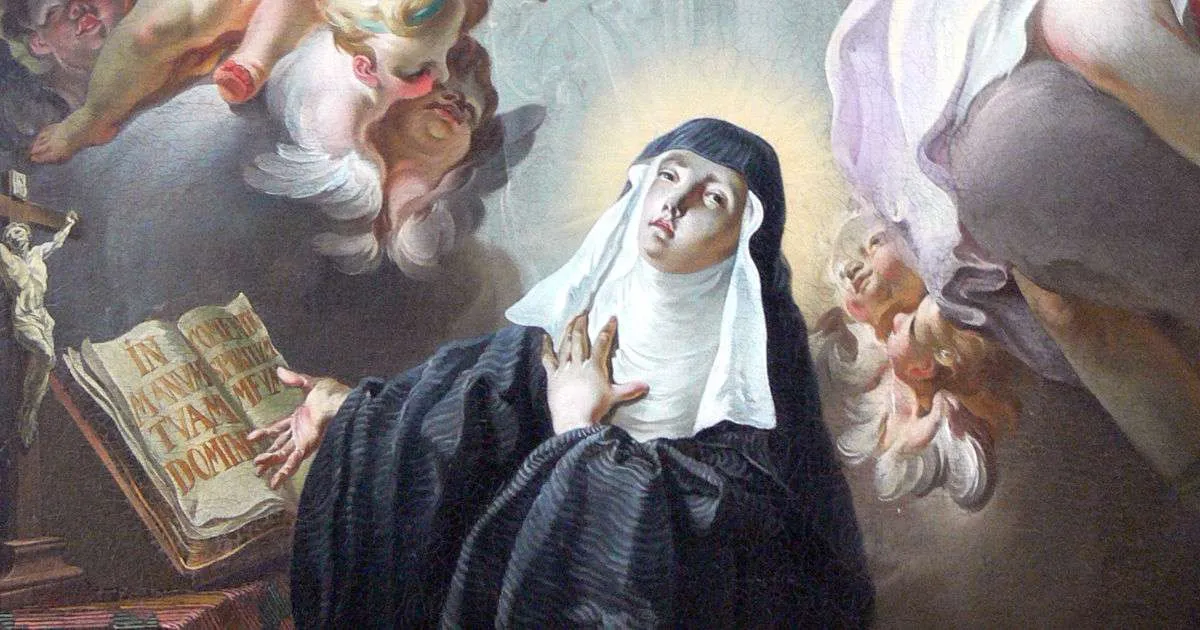
Memorial of Saint Scholastica, Virgin
Liturgical Color: White
Rosary Mysteries: Sorrowful Mysteries
“I asked you and you would not listen, so I asked my God and He did listen.”
Saint Scholastica
est. 480 – February 10, 543
Patron of nuns, school, tests, reading, convulsive children

Daily Readings
First Reading: 1 Kings 8: 22-23, 27-30
22 And Solomon stood before the altar of the Lord in the sight of the assembly of Israel, and spread forth his hands towards heaven;
23 And said: Lord God of Israel, there is no God like thee in heaven above, or on earth beneath: who keepest covenant and mercy with thy servants that have walked before thee with all their heart.
27 Is it then to be thought that God should indeed dwell upon earth? for if heaven, and the heavens of heavens cannot contain thee, how much less this house which I have built?
28 But have regard to the prayer of thy servant, and to his supplications, O Lord my God: hear the hymn and the prayer, which thy servant prayeth before thee this day:
29 That thy eyes may be open upon this house night and day: upon the house of which thou hast said: My name shall be there: that thou mayest hearken to the prayer, which thy servant prayeth in this place to thee.
30 That thou mayest hearken to the supplication of thy servant and of thy people Israel, whatsoever they shall pray for in this place, and hear them in the place of thy dwelling in heaven; and when thou hearest, shew them mercy.
22 Stetit autem Salomon ante altare Domini in conspectu ecclesiæ Israël, et expandit manus suas in cælum,
23 et ait: Domine Deus Israël, non est similis tui deus in cælo desuper, et super terram deorsum: qui custodis pactum et misericordiam servis tuis qui ambulant coram te in toto corde suo.
27 Ergone putandum est quod vere Deus habitet super terram? si enim cælum, et cæli cælorum, te capere non possunt, quanto magis domus hæc, quam ædificavi?
28 Sed respice ad orationem servi tui, et ad preces ejus, Domine Deus meus: audi hymnum et orationem quam servus tuus orat coram te hodie:
29 ut sint oculi tui aperti super domum hanc nocte ac die: super domum, de qua dixisti: Erit nomen meum ibi: ut exaudias orationem quam orat in loco isto ad te servus tuus:
30 ut exaudias deprecationem servi tui et populi tui Israël, quodcumque oraverint in loco isto, et exaudies in loco habitaculi tui in cælo: et cum exaudieris, propitius eris.
Gospel: Mark 7: 1-13
1 And there assembled together unto him the Pharisees and some of the scribes, coming from Jerusalem.
2 And when they had seen some of his disciples eat bread with common, that is, with unwashed hands, they found fault.
3 For the Pharisees, and all the Jews eat not without often washing their hands, holding the tradition of the ancients:
4 And when they come from the market, unless they be washed, they eat not: and many other things there are that have been delivered to them to observe, the washings of cups and of pots, and of brazen vessels, and of beds.
5 And the Pharisees and scribes asked him: Why do not thy disciples walk according to the tradition of the ancients, but they eat bread with common hands?
6 But he answering, said to them: Well did Isaias prophesy of you hypocrites, as it is written: This people honoureth me with their lips, but their heart is far from me.
7 And in vain do they worship me, teaching doctrines and precepts of men.
8 For leaving the commandment of God, you hold the tradition of men, the washing of pots and of cups: and many other things you do like to these.
9 And he said to them: Well do you make void the commandment of God, that you may keep your own tradition.
10 For Moses said: Honour thy father and thy mother; and He that shall curse father or mother, dying let him die.
11 But you say: If a man shall say to his father or mother, Corban, (which is a gift,) whatsoever is from me, shall profit thee.
12 And further you suffer him not to do any thing for his father or mother,
13 Making void the word of God by your own tradition, which you have given forth. And many other such like things you do.
1 Et conveniunt ad eum pharisæi, et quidam de scribis, venientes ab Jerosolymis.
2 Et cum vidissent quosdam ex discipulis ejus communibus manibus, id est non lotis, manducare panes, vituperaverunt.
3 Pharisæi enim, et omnes Judæi, nisi crebro laverint manus, non manducant, tenentes traditionem seniorum:
4 et a foro nisi baptizentur, non comedunt: et alia multa sunt, quæ tradita sunt illis servare, baptismata calicum, et urceorum, et æramentorum, et lectorum:
5 et interrogabant eum pharisæi et scribæ: Quare discipuli tui non ambulant juxta traditionem seniorum, sed communibus manibus manducant panem?
6 At ille respondens, dixit eis: Bene prophetavit Isaias de vobis hypocritis, sicut scriptum est: [Populus hic labiis me honorat,
cor autem eorum longe est a me:
7 in vanum autem me colunt,
docentes doctrinas, et præcepta hominum.]
8 Relinquentes enim mandatum Dei, tenetis traditionem hominum, baptismata urceorum et calicum: et alia similia his facitis multa.
9 Et dicebat illis: Bene irritum facitis præceptum Dei, ut traditionem vestram servetis.
10 Moyses enim dixit: Honora patrem tuum, et matrem tuam. Et: Qui maledixerit patri, vel matri, morte moriatur.
11 Vos autem dicitis: Si dixerit homo patri, aut matri, Corban (quod est donum) quodcumque ex me, tibi profuerit:
12 et ultra non dimittitis eum quidquam facere patri suo, aut matri,
13 rescindentes verbum Dei per traditionem vestram, quam tradidistis: et similia hujusmodi multa facitis.

A Daily Question from the Summa Theologica
Whether God alone, or the minister also, works inwardly unto the sacramental effect? (Article 1 of 10 of Question 64. Of the Causes of the Sacraments from the Treatise on the Sacraments)
Objection 1: It seems that not God alone, but also the minister, works inwardly unto the sacramental effect. For the inward sacramental effect is to cleanse man from sin and enlighten him by grace. But it belongs to the ministers of the Church “to cleanse, enlighten and perfect,” as Dionysius explains (Coel. Hier. v). Therefore it seems that the sacramental effect is the work not only of God, but also of the ministers of the Church.
Objection 2: Further, certain prayers are offered up in conferring the sacraments. But the prayers of the righteous are more acceptable to God than those of any other, according to Jn. 9:31: “If a man be a server of God, and doth His will, him He heareth.” Therefore it stems that a man obtains a greater sacramental effect if he receive it from a good minister. Consequently, the interior effect is partly the work of the minister and not of God alone.
Objection 3: Further, man is of greater account than an inanimate thing. But an inanimate thing contributes something to the interior effect: since “water touches the body and cleanses the soul,” as Augustine says (Tract. lxxx in Joan.). Therefore the interior sacramental effect is partly the work of man and not of God alone.
On the contrary, It is written (Rom. 8:33): “God that justifieth.” Since, then, the inward effect of all the sacraments is justification, it seems that God alone works the interior sacramental effect.
I answer that, There are two ways of producing an effect; first, as a principal agent; secondly, as an instrument. In the former way the interior sacramental effect is the work of God alone: first, because God alone can enter the soul wherein the sacramental effect takes place; and no agent can operate immediately where it is not: secondly, because grace which is an interior sacramental effect is from God alone, as we have established in the FS, Q[112], A[1]; while the character which is the interior effect of certain sacraments, is an instrumental power which flows from the principal agent, which is God. In the second way, however, the interior sacramental effect can be the work of man, in so far as he works as a minister. For a minister is of the nature of an instrument, since the action of both is applied to something extrinsic, while the interior effect is produced through the power of the principal agent, which is God.
Reply to Objection 1: Cleansing in so far as it is attributed to the ministers of the Church is not a washing from sin: deacons are said to “cleanse,” inasmuch as they remove the unclean from the body of the faithful, or prepare them by their pious admonitions for the reception of the sacraments. In like manner also priests are said to “enlighten” God’s people, not indeed by giving them grace, but by conferring on them the sacraments of grace; as Dionysius explains (Coel. Hier. v).
Reply to Objection 2: The prayers which are said in giving the sacraments, are offered to God, not on the part of the individual, but on the part of the whole Church, whose prayers are acceptable to God, according to Mat. 18:19: “If two of you shall consent upon earth, concerning anything whatsoever they shall ask, it shall be done to them by My Father.” Nor is there any reason why the devotion of a just man should not contribute to this effect. But that which is the sacramental effect is not impetrated by the prayer of the Church or of the minister, but through the merit of Christ’s Passion, the power of which operates in the sacraments, as stated above (Q[62], A[5]). Wherefore the sacramental effect is made no better by a better minister. And yet something in addition may be impetrated for the receiver of the sacrament through the devotion of the minister: but this is not the work of the minister, but the work of God Who hears the minister’s prayer.
Reply to Objection 3: Inanimate things do not produce the sacramental effect, except instrumentally, as stated above. In like manner neither do men produce the sacramental effect, except ministerially, as also stated above.
Continue reading the rest of the articles on Sacred Texts Archive website.