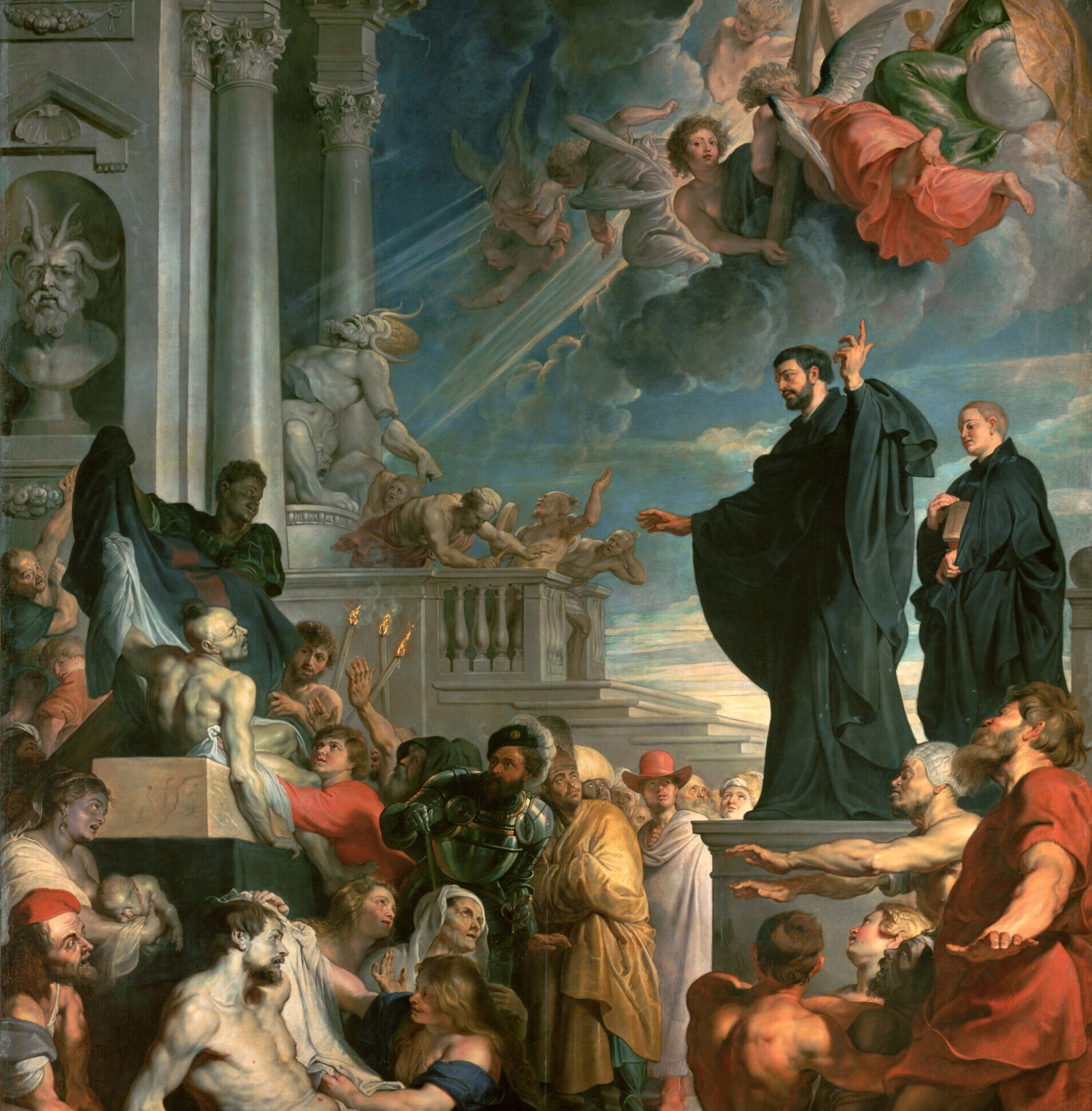
Memorial of Saint Francis Xavier, priest
Liturgical Color: White
Rosary Mysteries: Glorious Mysteries
“Would to God that these men who labor so much in gaining knowledge would give as much thought to the account they must one day give to God of the use they have made of their learning and of the talents entrusted to them!”
Saint Francis Xavier
April 7, 1506 – December 3, 1552
Patron of Catholic missions
Key Works: The Letters and Instructions of Francis Xavier

Daily Readings
First Reading: Isaiah 25:6-10a
6 On this mountain the LORD of hosts
will provide for all peoples
A feast of rich food and choice wines,
juicy, rich food and pure, choice wines.
7 On this mountain he will destroy
the veil that veils all peoples,
The web that is woven over all nations.
8 He will destroy death forever.
The Lord GOD will wipe away
the tears from all faces;
The reproach of his people he will remove
from the whole earth; for the LORD has spoken.
9 On that day it will be said:
“Indeed, this is our God; we looked to him, and he saved us!
This is the LORD to whom we looked;
let us rejoice and be glad that he has saved us!”
Judgment on Moab
10 For the hand of the LORD will rest on this mountain,
but Moab will be trodden down
as straw is trodden down in the mire.
6 Et faciet Dominus exercituum
omnibus populis in monte hoc
convivium pinguium,
convivium vindemiæ,
pinguium medullatorum,
vindemiæ defæcatæ.
7 Et præcipitabit in monte isto
faciem vinculi colligati super omnes populos,
et telam quam orditus est super omnes nationes.
8 Præcipitabit mortem in sempiternum;
et auferet Dominus Deus
lacrimam ab omni facie,
et opprobrium populi sui auferet
de universa terra:
quia Dominus locutus est.]
9 [Et dicet in die illa:
Ecce Deus noster iste;
exspectavimus eum, et salvabit nos;
iste Dominus, sustinuimus eum:
exsultabimus, et lætabimur in salutari ejus.
10 Quia requiescet manus Domini
in monte isto;
et triturabitur Moab sub eo,
sicuti teruntur paleæ in plaustro.
Gospel: Matthew 15: 29-37
The Healing of Many People.
29 Moving on from there Jesus walked by the Sea of Galilee, went up on the mountain, and sat down there.
30 Great crowds came to him, having with them the lame, the blind, the deformed, the mute, and many others. They placed them at his feet, and he cured them.
31 The crowds were amazed when they saw the mute speaking, the deformed made whole, the lame walking, and the blind able to see, and they glorified the God of Israel.
The Feeding of the Four Thousand
32 Jesus summoned his disciples and said, “My heart is moved with pity for the crowd, for they have been with me now for three days and have nothing to eat. I do not want to send them away hungry, for fear they may collapse on the way.”
33 The disciples said to him, “Where could we ever get enough bread in this deserted place to satisfy such a crowd?”
34 Jesus said to them, “How many loaves do you have?” “Seven,” they replied, “and a few fish.”
35 He ordered the crowd to sit down on the ground.
36 Then he took the seven loaves and the fish, gave thanks, broke the loaves, and gave them to the disciples, who in turn gave them to the crowds.
37 They all ate and were satisfied. They picked up the fragments left over—seven baskets full.
29 Et cum transisset inde Jesus, venit secus mare Galilææ: et ascendens in montem, sedebat ibi.
30 Et accesserunt ad eum turbæ multæ, habentes secum mutos, cæcos, claudos, debiles, et alios multos: et projecerunt eos ad pedes ejus, et curavit eos,
31 ita ut turbæ mirarentur, videntes mutos loquentes, claudos ambulantes, cæcos videntes: et magnificabant Deum Israël.
32 Jesus autem, convocatis discipulis suis, dixit: Misereor turbæ, quia triduo jam perseverant mecum, et non habent quod manducent: et dimittere eos jejunos nolo, ne deficiant in via.
33 Et dicunt ei discipuli: Unde ergo nobis in deserto panes tantos, ut saturemus turbam tantam?
34 Et ait illis Jesus: Quot habetis panes? At illi dixerunt: Septem, et paucos pisciculos.
35 Et præcepit turbæ ut discumberent super terram.
36 Et accipiens septem panes, et pisces, et gratias agens, fregit, et dedit discipulis suis, et discipuli dederunt populo.
37 Et comederunt omnes, et saturati sunt. Et quod superfuit de fragmentis, tulerunt septem sportas plenas.

A Daily Question from the Summa Theologica
Whether the foreknowledge of merits is the cause of predestination? (Article 5 of 8 of Question 23. OF PREDESTINATION from the Treatise on The One God)
Objection 1: It seems that foreknowledge of merits is the cause of predestination. For the Apostle says (Rom. 8:29): “Whom He foreknew, He also predestined.” Again a gloss of Ambrose on Rom. 9:15: “I will have mercy upon whom I will have mercy” says: “I will give mercy to him who, I foresee, will turn to Me with his whole heart.” Therefore it seems the foreknowledge of merits is the cause of predestination.
Objection 2: Further, Divine predestination includes the divine will, which by no means can be irrational; since predestination is “the purpose to have mercy,” as Augustine says (De Praed. Sanct. ii, 17). But there can be no other reason for predestination than the foreknowledge of merits. Therefore it must be the cause of reason of predestination.
Objection 3: Further, “There is no injustice in God” (Rom. 9:14). Now it would seem unjust that unequal things be given to equals. But all men are equal as regards both nature and original sin; and inequality in them arises from the merits or demerits of their actions. Therefore God does not prepare unequal things for men by predestinating and reprobating, unless through the foreknowledge of their merits and demerits.
On the contrary, The Apostle says (Titus 3:5): “Not by works of justice which we have done, but according to His mercy He saved us.” But as He saved us, so He predestined that we should be saved. Therefore, foreknowledge of merits is not the cause or reason of predestination.
I answer that, Since predestination includes will, as was said above (A[4]), the reason of predestination must be sought for in the same way as was the reason of the will of God. Now it was shown above (Q[19], A[5] ), that we cannot assign any cause of the divine will on the part of the act of willing; but a reason can be found on the part of the things willed; inasmuch as God wills one thing on account of something else. Wherefore nobody has been so insane as to say that merit is the cause of divine predestination as regards the act of the predestinator. But this is the question, whether, as regards the effect, predestination has any cause; or what comes to the same thing, whether God pre-ordained that He would give the effect of predestination to anyone on account of any merits.
Accordingly there were some who held that the effect of predestination was pre-ordained for some on account of pre-existing merits in a former life. This was the opinion of Origen, who thought that the souls of men were created in the beginning, and according to the diversity of their works different states were assigned to them in this world when united with the body. The Apostle, however, rebuts this opinion where he says (Rom. 9:11, 12): “For when they were not yet born, nor had done any good or evil . . . not of works, but of Him that calleth, it was said of her: The elder shall serve the younger.”
Others said that pre-existing merits in this life are the reason and cause of the effect of predestination. For the Pelagians taught that the beginning of doing well came from us; and the consummation from God: so that it came about that the effect of predestination was granted to one, and not to another, because the one made a beginning by preparing, whereas the other did not. But against this we have the saying of the Apostle (2 Cor. 3:5), that “we are not sufficient to think anything of ourselves as of ourselves.” Now no principle of action can be imagined previous to the act of thinking. Wherefore it cannot be said that anything begun in us can be the reason of the effect of predestination.
And so others said that merits following the effect of predestination are the reason of predestination; giving us to understand that God gives grace to a person, and pre-ordains that He will give it, because He knows beforehand that He will make good use of that grace, as if a king were to give a horse to a soldier because he knows he will make good use of it. But these seem to have drawn a distinction between that which flows from grace, and that which flows from free will, as if the same thing cannot come from both. It is, however, manifest that what is of grace is the effect of predestination; and this cannot be considered as the reason of predestination, since it is contained in the notion of predestination. Therefore, if anything else in us be the reason of predestination, it will outside the effect of predestination. Now there is no distinction between what flows from free will, and what is of predestination; as there is not distinction between what flows from a secondary cause and from a first cause. For the providence of God produces effects through the operation of secondary causes, as was above shown (Q[22], A[3]). Wherefore, that which flows from free-will is also of predestination. We must say, therefore, that the effect of predestination may be considered in a twofold light—in one way, in particular; and thus there is no reason why one effect of predestination should not be the reason or cause of another; a subsequent effect being the reason of a previous effect, as its final cause; and the previous effect being the reason of the subsequent as its meritorious cause, which is reduced to the disposition of the matter. Thus we might say that God pre-ordained to give glory on account of merit, and that He pre-ordained to give grace to merit glory. In another way, the effect of predestination may be considered in general. Thus, it is impossible that the whole of the effect of predestination in general should have any cause as coming from us; because whatsoever is in man disposing him towards salvation, is all included under the effect of predestination; even the preparation for grace. For neither does this happen otherwise than by divine help, according to the prophet Jeremias (Lam. 5:21): “convert us, O Lord, to Thee, and we shall be converted.” Yet predestination has in this way, in regard to its effect, the goodness of God for its reason; towards which the whole effect of predestination is directed as to an end; and from which it proceeds, as from its first moving principle.
Reply to Objection 1: The use of grace foreknown by God is not the cause of conferring grace, except after the manner of a final cause; as was explained above.
Reply to Objection 2: Predestination has its foundation in the goodness of God as regards its effects in general. Considered in its particular effects, however, one effect is the reason of another; as already stated.
Reply to Objection 3: The reason for the predestination of some, and reprobation of others, must be sought for in the goodness of God. Thus He is said to have made all things through His goodness, so that the divine goodness might be represented in things. Now it is necessary that God’s goodness, which in itself is one and undivided, should be manifested in many ways in His creation; because creatures in themselves cannot attain to the simplicity of God. Thus it is that for the completion of the universe there are required different grades of being; some of which hold a high and some a low place in the universe. That this multiformity of grades may be preserved in things, God allows some evils, lest many good things should never happen, as was said above (Q[22], A[2]). Let us then consider the whole of the human race, as we consider the whole universe. God wills to manifest His goodness in men; in respect to those whom He predestines, by means of His mercy, as sparing them; and in respect of others, whom he reprobates, by means of His justice, in punishing them. This is the reason why God elects some and rejects others. To this the Apostle refers, saying (Rom. 9:22, 23): “What if God, willing to show His wrath [that is, the vengeance of His justice], and to make His power known, endured [that is, permitted] with much patience vessels of wrath, fitted for destruction; that He might show the riches of His glory on the vessels of mercy, which He hath prepared unto glory” and (2 Tim. 2:20): “But in a great house there are not only vessels of gold and silver; but also of wood and of earth; and some, indeed, unto honor, but some unto dishonor.” Yet why He chooses some for glory, and reprobates others, has no reason, except the divine will. Whence Augustine says (Tract. xxvi. in Joan.): “Why He draws one, and another He draws not, seek not to judge, if thou dost not wish to err.” Thus too, in the things of nature, a reason can be assigned, since primary matter is altogether uniform, why one part of it was fashioned by God from the beginning under the form of fire, another under the form of earth, that there might be a diversity of species in things of nature. Yet why this particular part of matter is under this particular form, and that under another, depends upon the simple will of God; as from the simple will of the artificer it depends that this stone is in part of the wall, and that in another; although the plan requires that some stones should be in this place, and some in that place. Neither on this account can there be said to be injustice in God, if He prepares unequal lots for not unequal things. This would be altogether contrary to the notion of justice, if the effect of predestination were granted as a debt, and not gratuitously. In things which are given gratuitously, a person can give more or less, just as he pleases (provided he deprives nobody of his due), without any infringement of justice. This is what the master of the house said: “Take what is thine, and go thy way. Is it not lawful for me to do what I will?” (Matt. 20:14, 15).
Continue reading the rest of the articles on Sacred Texts Archive website.
Scripture texts in this work are taken from the New American Bible, revised edition © 2010, 1991, 1986, 1970 Confraternity of Christian Doctrine, Washington, D.C.