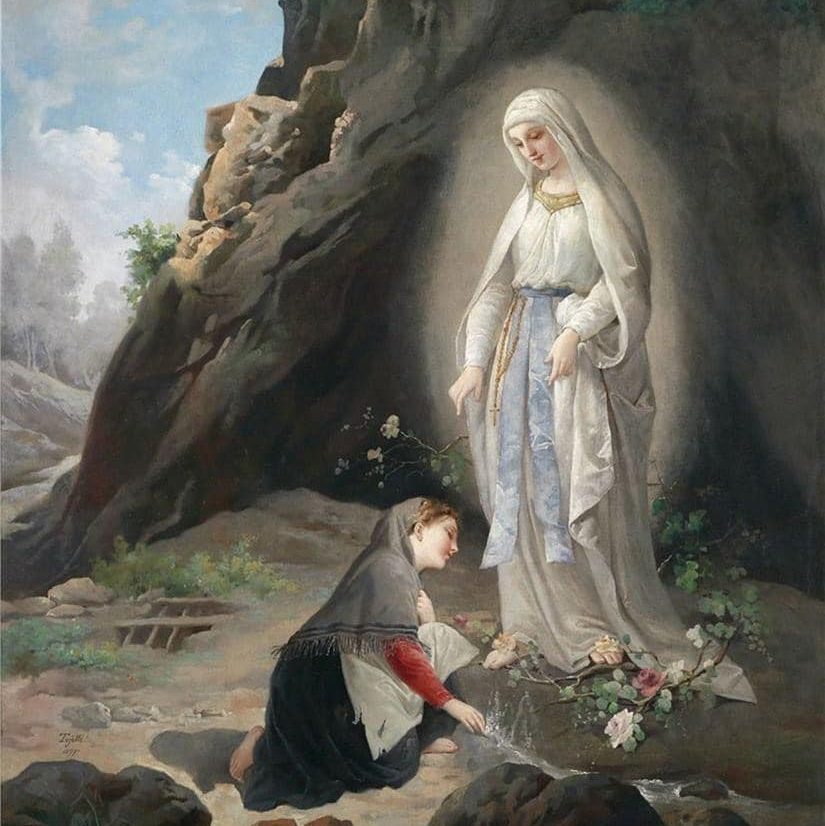
Optional Memorial of Our Lady of Lourdes
Liturgical Color: Green / White
Rosary Mysteries: Glorious Mysteries

Daily Readings
First Reading: 1 Kings 10: 1-10
1 And the queen of Saba, having; heard of the fame of Solomon in the name of the Lord, came to try him with hard questions.
2 And entering into Jerusalem with a great train, and riches, and camels that carried spices, and an immense quantity of gold, and precious stones, she came to king Solomon, and spoke to him all that she had in her heart.
3 And Solomon informed her of all the things she proposed to him: there was not any word the king was ignorant of, and which he could not answer her.
4 And when the queen of Saba saw all the wisdom of Solomon, and the house which he had built,
5 And the meat of his table, and the apartments of his servants, and the order of his ministers, and their apparel, and the cupbearers, and the holocausts, which he offered in the house of the Lord: she had no longer any spirit in her,
6 And she said to the king: The report is true, which I heard in my own country,
7 Concerning thy words, and concerning thy wisdom. And I did not believe them that told me, till I came myself, and saw with my own eyes, and have found that the half hath not been told me: thy wisdom and thy works, exceed the fame which I heard.
8 Blessed are thy men, and blessed are thy servants, who stand before thee always, and hear thy wisdom.
9 Blessed be the Lord thy God, whom thou hast pleased, and who hath set thee upon the throne of Israel, because the Lord hath loved Israel for ever, and hath appointed thee king, to do judgment and justice.
10 And she gave the king a hundred and twenty talents of gold, and of spices a very great store, and precious stones: there was brought no more such abundance of spices as these which the queen of Saba gave to king Solomon.
1 Sed et regina Saba, audita fama Salomonis in nomine Domini, venit tentare eum in ænigmatibus.
2 Et ingressa Jerusalem multo cum comitatu et divitiis, camelis portantibus aromata, et aurum infinitum nimis, et gemmas pretiosas, venit ad regem Salomonem, et locuta est ei universa quæ habebat in corde suo.
3 Et docuit eam Salomon omnia verba quæ proposuerat: non fuit sermo qui regem posset latere, et non responderet ei.
4 Videns autem regina Saba omnem sapientiam Salomonis, et domum quam ædificaverat,
5 et cibos mensæ ejus, et habitacula servorum, et ordines ministrantium, vestesque eorum, et pincernas, et holocausta quæ offerebat in domo Domini: non habebat ultra spiritum.
6 Dixitque ad regem: Verus est sermo quem audivi in terra mea
7 super sermonibus tuis, et super sapientia tua: et non credebam narrantibus mihi, donec ipsa veni, et vidi oculis meis, et probavi quod media pars mihi nuntiata non fuerit: major est sapientia et opera tua, quam rumor quem audivi.
8 Beati viri tui, et beati servi tui, qui stant coram te semper, et audiunt sapientiam tuam.
9 Sit Dominus Deus tuus benedictus, cui complacuisti, et posuit te super thronum Israël, eo quod dilexerit Dominus Israël in sempiternum, et constituit te regem ut faceres judicium et justitiam.
10 Dedit ergo regi centum viginti talenta auri, et aromata multa nimis, et gemmas pretiosas: non sunt allata ultra aromata tam multa, quam ea quæ dedit regina Saba regi Salomoni.
Gospel: Mark 7: 14-23
14 And calling again the multitude unto him, he said to them: Hear ye me all, and understand.
15 There is nothing from without a man that entering into him, can defile him. But the things which come from a man, those are they that defile a man.
16 If any man have ears to hear, let him hear.
17 And when he was come into the house from the multitude, his disciples asked him the parable.
18 And he saith to them: So are you also without knowledge? understand you not that every thing from without, entering into a man cannot defile him:
19 Because it entereth not into his heart, but goeth into the belly, and goeth out into the privy, purging all meats?
20 But he said that the things which come out from a man, they defile a man.
21 For from within out of the heart of men proceed evil thoughts, adulteries, fornications, murders,
22 Thefts, covetousness, wickedness, deceit, lasciviousness, an evil eye, blasphemy, pride, foolishness.
23 All these evil things come from within, and defile a man.
14 Et advocans iterum turbam, dicebat illis: Audite me omnes, et intelligite.
15 Nihil est extra hominem introiens in eum, quod possit eum coinquinare, sed quæ de homine procedunt illa sunt quæ communicant hominem.
16 Si quis habet aures audiendi, audiat.
17 Et cum introisset in domum a turba, interrogabant eum discipuli ejus parabolam.
18 Et ait illis: Sic et vos imprudentes estis? Non intelligitis quia omne extrinsecus introiens in hominem, non potest eum communicare:
19 quia non intrat in cor ejus, sed in ventrum vadit, et in secessum exit, purgans omnes escas?
20 Dicebat autem, quoniam quæ de homine exeunt, illa communicant hominem.
21 Ab intus enim de corde hominum malæ cogitationes procedunt, adulteria, fornicationes, homicidia,
22 furta, avaritiæ, nequitiæ, dolus, impudicitiæ, oculus malus, blasphemia, superbia, stultitia.
23 Omnia hæc mala ab intus procedunt, et communicant hominem.

A Daily Question from the Summa Theologica
Whether the sacraments are instituted by God alone? (Article 2 of 10 of Question 64. Of the Causes of the Sacraments from the Treatise on the Sacraments)
Objection 1: It seems that the sacraments are not instituted by God alone. For those things which God has instituted are delivered to us in Holy Scripture. But in the sacraments certain things are done which are nowhere mentioned in Holy Scripture; for instance, the chrism with which men are confirmed, the oil with which priests are anointed, and many others, both words and actions, which we employ in the sacraments. Therefore the sacraments were not instituted by God alone.
Objection 2: Further, a sacrament is a kind of sign. Now sensible things have their own natural signification. Nor can it be said that God takes pleasure in certain significations and not in others; because He approves of all that He made. Moreover, it seems to be peculiar to the demons to be enticed to something by means of signs; for Augustine says (De Civ. Dei xxi): “The demons are enticed . . . by means of creatures, which were created not by them but by God, by various means of attraction according to their various natures, not as an animal is enticed by food, but as a spirit is drawn by a sign.” It seems, therefore, that there is no need for the sacraments to be instituted by God.
Objection 3: Further, the apostles were God’s vicegerents on earth: hence the Apostle says (2 Cor. 2:10): “For what I have pardoned, if I have pardoned anything, for your sakes have I done it in the person of Christ,” i.e. as though Christ Himself had pardoned. Therefore it seems that the apostles and their successors can institute new sacraments.
On the contrary, The institutor of anything is he who gives it strength and power: as in the case of those who institute laws. But the power of a sacrament is from God alone, as we have shown above (A[1]; Q[62], A[1]). Therefore God alone can institute a sacrament.
I answer that, As appears from what has been said above (A[1]; Q[62], A[1]), the sacraments are instrumental causes of spiritual effects. Now an instrument has its power from the principal agent. But an agent in respect of a sacrament is twofold; viz. he who institutes the sacraments, and he who makes use of the sacrament instituted, by applying it for the production of the effect. Now the power of a sacrament cannot be from him who makes use of the sacrament: because he works but as a minister. Consequently, it follows that the power of the sacrament is from the institutor of the sacrament. Since, therefore, the power of the sacrament is from God alone, it follows that God alone can institute the sacraments.
Reply to Objection 1: Human institutions observed in the sacraments are not essential to the sacrament; but belong to the solemnity which is added to the sacraments in order to arouse devotion and reverence in the recipients. But those things that are essential to the sacrament, are instituted by Christ Himself, Who is God and man. And though they are not all handed down by the Scriptures, yet the Church holds them from the intimate tradition of the apostles, according to the saying of the Apostle (1 Cor. 11:34): “The rest I will set in order when I come.”
Reply to Objection 2: From their very nature sensible things have a certain aptitude for the signifying of spiritual effects: but this aptitude is fixed by the Divine institution to some special signification. This is what Hugh of St. Victor means by saying (De Sacram. i) that “a sacrament owes its signification to its institution.” Yet God chooses certain things rather than others for sacramental signification, not as though His choice were restricted to them, but in order that their signification be more suitable to them.
Reply to Objection 3: The apostles and their successors are God’s vicars in governing the Church which is built on faith and the sacraments of faith. Wherefore, just as they may not institute another Church, so neither may they deliver another faith, nor institute other sacraments: on the contrary, the Church is said to be built up with the sacraments “which flowed from the side of Christ while hanging on the Cross.”
Continue reading the rest of the articles on Sacred Texts Archive website.