Lenten Weekday
LITurgical Color: Violet
Rosary Mysteries: Glorious Mysteries

Daily Readings
Gospel: Luke 11: 29-32
29 And the multitudes running together, he began to say: This generation is a wicked generation: it asketh a sign, and a sign shall not be given it, but the sign of Jonas the prophet.
30 For as Jonas was a sign to the Ninivites; so shall the Son of man also be to this generation.
31 The queen of the south shall rise in the judgment with the men of this generation, and shall condemn them: because she came from the ends of the earth to hear the wisdom of Solomon; and behold more than Solomon here.
32 The men of Ninive shall rise in the judgment with this generation, and shall condemn it; because they did penance at the preaching of Jonas; and behold more than Jonas here.
29 Turbis autem concurrentibus cœpit dicere: Generatio hæc, generatio nequam est: signum quærit, et signum non dabitur ei, nisi signum Jonæ prophetæ.
30 Nam sicut fuit Jonas signum Ninivitis, ita erit et Filius hominis generationi isti.
31 Regina austri surget in judicio cum viris generationis hujus, et condemnabit illos: quia venit a finibus terræ audire sapientiam Salomonis: et ecce plus quam Salomon hic.
32 Viri Ninivitæ surgent in judicio cum generatione hac, et condemnabunt illam: quia pœnitentiam egerunt ad prædicationem Jonæ, et ecce plus quam Jonas hic.
First Reading: Jonah 3: 1-10
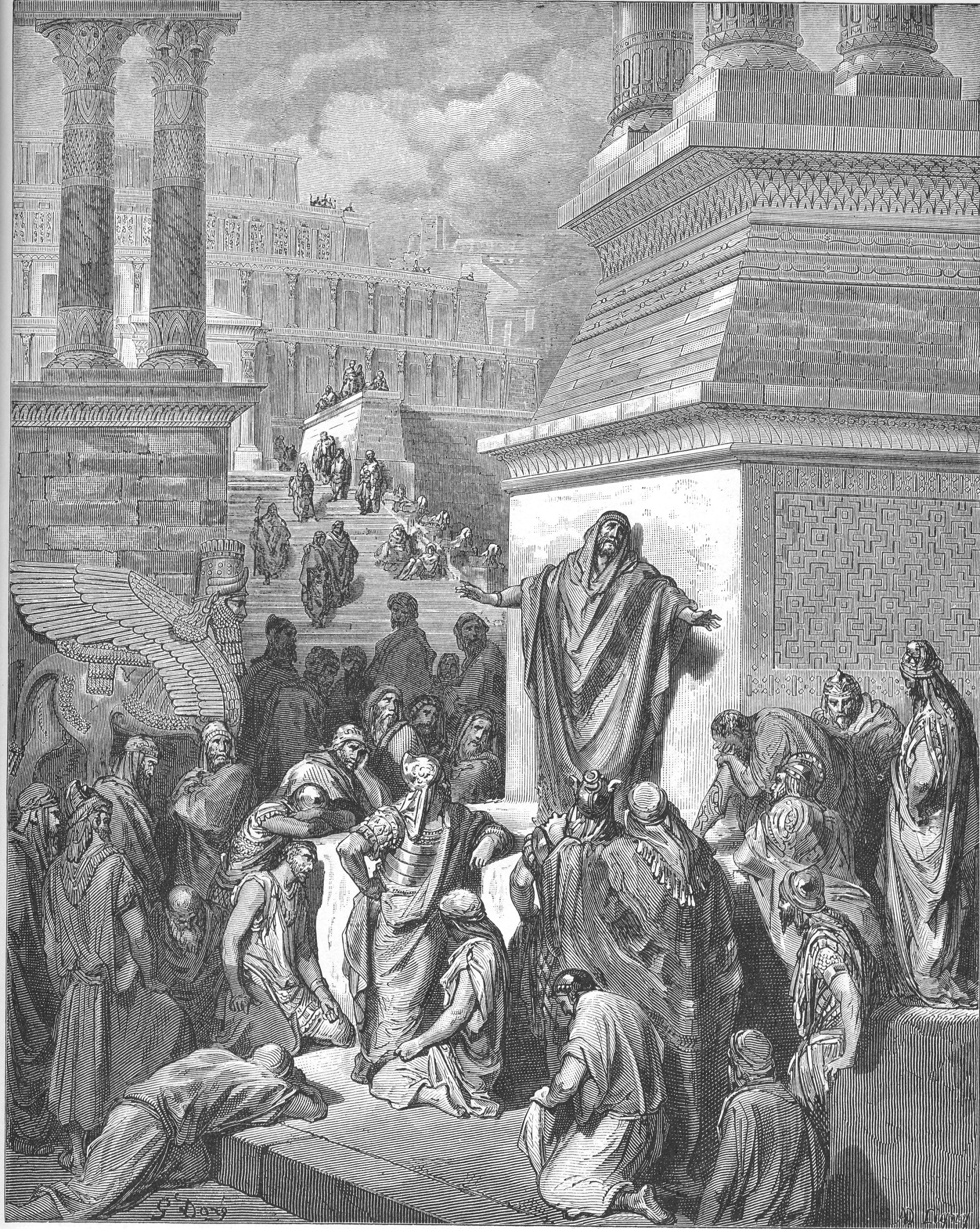
1 And the word of the Lord came to Jonas the second time, saying:
2 Arise, and go to Ninive the great city: and preach in it the preaching that I bid thee.
3 And Jonas arose, and went to Ninive, according to the word of the Lord: now Ninive was a great city of three days’ journey.
4 And Jonas began to enter into the city one day’s journey: and he cried, and said: Yet forty days, and Ninive shall be destroyed.
5 And the men of Ninive believed in God: and they proclaimed a fast, and put on sackcloth from the greatest to the least.
6 And the word came to the king of Ninive; and he rose up out of his throne, and cast away his robe from him, and was clothed with sackcloth, and sat in ashes.
7 And he caused it to be proclaimed and published in Ninive from the mouth of the king and of his princes, saying: Let neither men nor beasts, oxen nor sheep, taste any thing: let them not feed, nor drink water.
8 And let men and beasts be covered with sackcloth, and cry to the Lord with all their strength, and let them turn every one from his evil way, and from the iniquity that is in their hands.
9 Who can tell if God will turn, and forgive: and will turn away from his fierce anger, and we shall not perish?
10 And God saw their works, that they were turned from their evil way: and God had mercy with regard to the evil which he had said that he would do to them, and he did it not.
1 Et factum est verbum Domini ad Jonam secundo, dicens:
2 Surge, et vade in Niniven, civitatem magnam, et prædica in ea prædicationem quam ego loquor ad te.
3 Et surrexit Jonas, et abiit in Niniven juxta verbum Domini: et Ninive erat civitas magna, itinere trium dierum.
4 Et cœpit Jonas introire in civitatem itinere diei unius: et clamavit, et dixit: Adhuc quadraginta dies, et Ninive subvertetur.
5 Et crediderunt viri Ninivitæ in Deum, et prædicaverunt jejunium, et vestiti sunt saccis, a majore usque ad minorem.
6 Et pervenit verbum ad regem Ninive: et surrexit de solio suo, et abjecit vestimentum suum a se, et indutus est sacco, et sedit in cinere.
7 Et clamavit, et dixit in Ninive ex ore regis et principum ejus, dicens: Homines, et jumenta, et boves, et pecora non gustent quidquam: nec pascantur, et aquam non bibant.
8 Et operiantur saccis homines et jumenta, et clament ad Dominum in fortitudine: et convertatur vir a via sua mala, et ab iniquitate quæ est in manibus eorum.
9 Quis scit si convertatur et ignoscat Deus, et revertatur a furore iræ suæ, et non peribimus?
10 Et vidit Deus opera eorum, quia conversi sunt de via sua mala: et misertus est Deus super malitiam quam locutus fuerat ut faceret eis, et non fecit.

A Daily Question from the Summa Theologica
Whether the Eucharist is a sacrament? (Article 1 of 6 of Question 73. Of the Sacrifice of the Eucharist from the Treatise on the Sacraments)
Objection 1: It seems that the Eucharist is not a sacrament. For two sacraments ought not to be ordained for the same end, because every sacrament is efficacious in producing its effect. Therefore, since both Confirmation and the Eucharist are ordained for perfection, as Dionysius says (Eccl. Hier. iv), it seems that the Eucharist is not a sacrament, since Confirmation is one, as stated above (Q[65], A[1]; Q[72], A[1]).
Objection 2: Further, in every sacrament of the New Law, that which comes visibly under our senses causes the invisible effect of the sacrament, just as cleansing with water causes the baptismal character and spiritual cleansing, as stated above (Q[63], A[6]; Q[66], AA[1],3,7). But the species of bread and wine, which are the objects of our senses in this sacrament, neither produce Christ’s true body, which is both reality and sacrament, nor His mystical body, which is the reality only in the Eucharist. Therefore, it seems that the Eucharist is not a sacrament of the New Law.
Objection 3: Further, sacraments of the New Law, as having matter, are perfected by the use of the matter, as Baptism is by ablution, and Confirmation by signing with chrism. If, then, the Eucharist be a sacrament, it would be perfected by the use of the matter, and not by its consecration. But this is manifestly false, because the words spoken in the consecration of the matter are the form of this sacrament, as will be shown later on (Q[78], A[1]). Therefore the Eucharist is not a sacrament.
On the contrary, It is said in the Collect [*Postcommunion “pro vivis et defunctis”]: “May this Thy Sacrament not make us deserving of punishment.”
I answer that, The Church’s sacraments are ordained for helping man in the spiritual life. But the spiritual life is analogous to the corporeal, since corporeal things bear a resemblance to spiritual. Now it is clear that just as generation is required for corporeal life, since thereby man receives life; and growth, whereby man is brought to maturity: so likewise food is required for the preservation of life. Consequently, just as for the spiritual life there had to be Baptism, which is spiritual generation; and Confirmation, which is spiritual growth: so there needed to be the sacrament of the Eucharist, which is spiritual food.
Reply to Objection 1: Perfection is twofold. The first lies within man himself; and he attains it by growth: such perfection belongs to Confirmation. The other is the perfection which comes to man from the addition of food, or clothing, or something of the kind; and such is the perfection befitting the Eucharist, which is the spiritual refreshment.
Reply to Objection 2: The water of Baptism does not cause any spiritual effect by reason of the water, but by reason of the power of the Holy Ghost, which power is in the water. Hence on Jn. 5:4, “An angel of the Lord at certain times,” etc., Chrysostom observes: “The water does not act simply as such upon the baptized, but when it receives the grace of the Holy Ghost, then it looses all sins.” But the true body of Christ. bears the same relation to the species of the bread and wine, as the power of the Holy Ghost does to the water of Baptism: hence the species of the bread and wine produce no effect except from the virtue of Christ’s true body.
Reply to Objection 3: A sacrament is so termed because it contains something sacred. Now a thing can be styled sacred from two causes; either absolutely, or in relation to something else. The difference between the Eucharist and other sacraments having sensible matter is that whereas the Eucharist contains something which is sacred absolutely, namely, Christ’s own body; the baptismal water contains something which is sacred in relation to something else, namely, the sanctifying power: and the same holds good of chrism and such like. Consequently, the sacrament of the Eucharist is completed in the very consecration of the matter, whereas the other sacraments are completed in the application of the matter for the sanctifying of the individual. And from this follows another difference. For, in the sacrament of the Eucharist, what is both reality and sacrament is in the matter itself. but what is reality only, namely, the grace bestowed, is in the recipient; whereas in Baptism both are in the recipient, namely, the character, which is both reality and sacrament, and the grace of pardon of sins, which is reality only. And the same holds good of the other sacraments.
Continue reading the rest of the articles on Sacred Texts Archive website.