Weekday
Liturgical Color: Green
Rosary Mysteries: Glorious Mysteries

Daily Readings
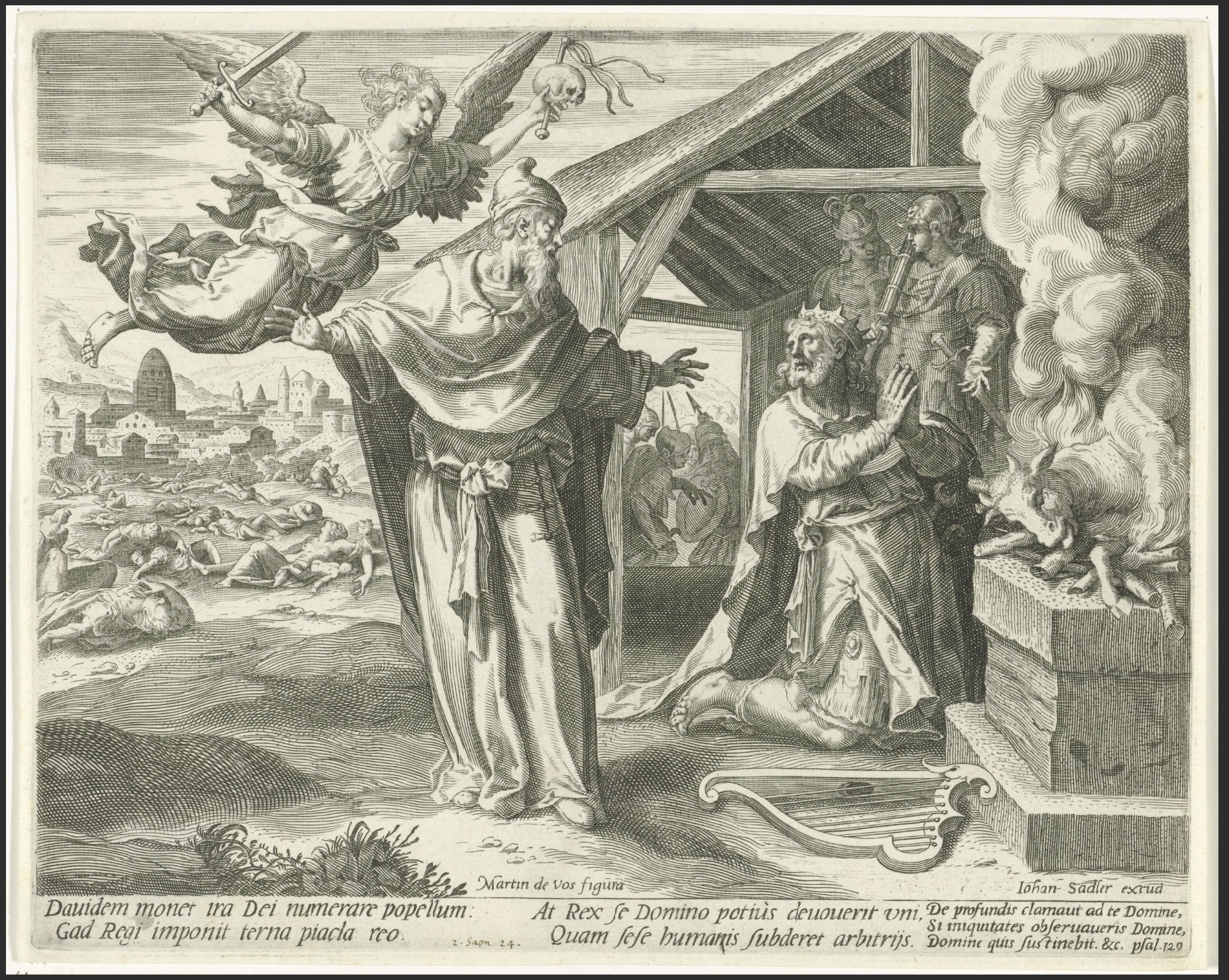
First Reading: 2 Samuel 24: 2, 9-17
2 And the king said to Joab the general of his army: Go through all the tribes of Israel from Dan to Bersabee, and number ye the people that I may know the number of them.
9 And Joab gave up the sum of the number of the people to the king, and there were found of Israel eight hundred thousand valiant men that drew the sword: and of Juda five hundred thousand fighting men.
10 But David’s heart struck him, after the people were numbered: and David said to the Lord: I have sinned very much in what I have done: but I pray thee, O Lord, to take away the iniquity of thy servant, because I have done exceeding foolishly.
11 And David arose in the morning, and the word of the Lord came to Gad the prophet and the seer of David, saying:
12 Go, and say to David: Thus saith the Lord: I give thee thy choice of three things, choose one of them which thou wilt, that I may do it to thee.
13 And when Gad was come to David, he told him, saying: Either seven years of famine shall come to thee in thy land: or thou shalt flee three months before thy adversaries, and they shall pursue thee: or for three days there shall be a pestilence in thy land. Now therefore deliberate, and see what answer I shall return to him that sent me.
14 And David said to Gad: I am in a great strait: but it is better that I should fall into the hands of the Lord (for his mercies are many) than into the hands of men.
15 And the Lord sent a pestilence upon Israel, from the morning unto the time appointed, and there died of the people from Dan to Bersabee seventy thousand men.
16 And when the angel of the Lord had stretched out his hand over Jerusalem to destroy it, the Lord had pity on the affliction, and said to the angel that slew the people: It is enough: now hold thy hand. And the angel of the Lord was by the threshingfloor of Areuna the Jebusite.
17 And David said to the Lord, when he saw the angel striking the people: It is I; I am he that have sinned, I have done wickedly: these that are the sheep, what have they done? let thy hand, I beseech thee, be turned against me, and against my father’s house.
2 Dixitque rex ad Joab principem exercitus sui: Perambula omnes tribus Israël a Dan usque Bersabee, et numerate populum, ut sciam numerum ejus.
9 Dedit ergo Joab numerum descriptionis populi regi, et inventa sunt de Israël octingenta millia virorum fortium qui educerent gladium, et de Juda quingenta millia pugnatorum.
10 Percussit autem cor David eum, postquam numeratus est populus: et dixit David ad Dominum: Peccavi valde in hoc facto: sed precor, Domine, ut transferas iniquitatem servi tui, quia stulte egi nimis.
11 Surrexit itaque David mane, et sermo Domini factus est ad Gad prophetam et videntem David, dicens:
12 Vade, et loquere ad David: Hæc dicit Dominus: Trium tibi datur optio: elige unum quod volueris ex his, ut faciam tibi.
13 Cumque venisset Gad ad David, nuntiavit ei, dicens: Aut septem annis veniet tibi fames in terra tua: aut tribus mensibus fugies adversarios tuos, et ille te persequentur: aut certe tribus diebus erit pestilentia in terra tua. Nunc ergo delibera, et vide quem respondeam ei qui me misit sermonem.
14 Dixit autem David ad Gad: Coarctor nimis: sed melius est ut incidam in manus Domini (multæ enim misericordiæ ejus sunt) quam in manus hominum.
15 Immisitque Dominus pestilentiam in Israël, de mane usque ad tempus constitutum, et mortui sunt ex populo a Dan usque ad Bersabee septuaginta millia virorum.
16 Cumque extendisset manum suam angelus Domini super Jerusalem ut disperderet eam, misertus est Dominus super afflictione, et ait angelo percutienti populum: Sufficit: nunc contine manum tuam. Erat autem angelus Domini juxta aream Areuna Jebusæi.
17 Dixitque David ad Dominum cum vidisset angelum cædentem populum: Ego sum qui peccavi, ego inique egi: isti qui oves sunt, quid fecerunt? vertatur, obsecro, manus tua contra me, et contra domum patris mei.
Gospel: Mark 6; 1-6
1 And going out from thence, he went into his own country; and his disciples followed him.
2 And when the sabbath was come, he began to teach in the synagogue: and many hearing him were in admiration at his doctrine, saying: How came this man by all these things? and what wisdom is this that is given to him, and such mighty works as are wrought by his hands?
3 Is not this the carpenter, the son of Mary, the brother of James, and Joseph, and Jude, and Simon? are not also his sisters here with us? And they were scandalized in regard of him.
4 And Jesus said to them: A prophet is not without honor, but in his own country, and in his own house, and among his own kindred.
5 And he could not do any miracles there, only that he cured a few that were sick, laying his hands upon them.
6 And he wondered because of their unbelief, and he went through the villages round about teaching.
1 Et egressus inde, abiit in patriam suam: et sequebantur eum discipuli sui:
2 et facto sabbato cœpit in synagoga docere: et multi audientes admirabantur in doctrina ejus, dicentes: Unde huic hæc omnia? et quæ est sapientia, quæ data est illi, et virtutes tales, quæ per manus ejus efficiuntur?
3 Nonne hic est faber, filius Mariæ, frater Jacobi, et Joseph, et Judæ, et Simonis? nonne et sorores ejus hic nobiscum sunt? Et scandalizabantur in illo.
4 Et dicebat illis Jesus: Quia non est propheta sine honore nisi in patria sua, et in domo sua, et in cognatione sua.
5 Et non poterat ibi virtutem ullam facere, nisi paucos infirmos impositis manibus curavit:
6 et mirabatur propter incredulitatem eorum, et circuibat castella in circuitu docens.

A Daily Question from the Summa Theologica
Whether a sacrament imprints a character on the soul? (Article 1 of 6 of Question 63. Of the Other Effect of the Sacrament Which is a Character from the Treatise on the Sacraments)
Objection 1: It seems that a sacrament does not imprint a character on the soul. For the word “character” seems to signify some kind of distinctive sign. But Christ’s members are distinguished from others by eternal predestination, which does not imply anything in the predestined, but only in God predestinating, as we have stated in the FP, Q[23], A[2]. For it is written (2 Tim. 2:19): “The sure foundation of God standeth firm, having this seal: The Lord knoweth who are His.” Therefore the sacraments do not imprint a character on the soul.
Objection 2: Further, a character is a distinctive sign. Now a sign, as Augustine says (De Doctr. Christ. ii) “is that which conveys something else to the mind, besides the species which it impresses on the senses.” But nothing in the soul can impress a species on the senses. Therefore it seems that no character is imprinted on the soul by the sacraments.
Objection 3: Further, just as the believer is distinguished from the unbeliever by the sacraments of the New Law, so was it under the Old Law. But the sacraments of the Old Law did not imprint a character; whence they are called “justices of the flesh” (Heb. 9:10) by the Apostle. Therefore neither seemingly do the sacraments of the New Law.
On the contrary, The Apostle says (2 Cor. 1:21, 22): “He . . . that hath anointed us is God; Who also hath sealed us, and given the pledge of the spirit in our hearts.” But a character means nothing else than a kind of sealing. Therefore it seems that by the sacraments God imprints His character on us.
I answer that, As is clear from what has been already stated (Q[62], A[5]) the sacraments of the New Law are ordained for a twofold purpose; namely, for a remedy against sins; and for the perfecting of the soul in things pertaining to the Divine worship according to the rite of the Christian life. Now whenever anyone is deputed to some definite purpose he is wont to receive some outward sign thereof; thus in olden times soldiers who enlisted in the ranks used to be marked with certain characters on the body, through being deputed to a bodily service. Since, therefore, by the sacraments men are deputed to a spiritual service pertaining to the worship of God, it follows that by their means the faithful receive a certain spiritual character. Wherefore Augustine says (Contra Parmen. ii): “If a deserter from the battle, through dread of the mark of enlistment on his body, throws himself on the emperor’s clemency, and having besought and received mercy, return to the fight; is that character renewed, when the man has been set free and reprimanded? is it not rather acknowledged and approved? Are the Christian sacraments, by any chance, of a nature less lasting than this bodily mark?”
Reply to Objection 1: The faithful of Christ are destined to the reward of the glory that is to come, by the seal of Divine Predestination. But they are deputed to acts becoming the Church that is now, by a certain spiritual seal that is set on them, and is called a character.
Reply to Objection 2: The character imprinted on the soul is a kind of sign in so far as it is imprinted by a sensible sacrament: since we know that a certain one has received the baptismal character, through his being cleansed by the sensible water. Nevertheless from a kind of likeness, anything that assimilates one thing to another, or discriminates one thing from another, even though it be not sensible, can be called a character or a seal; thus the Apostle calls Christ “the figure” or “of the substance of the Father” (Heb. 1:3).
Reply to Objection 3: As stated above (Q[62], A[6]) the sacraments of the Old Law had not in themselves any spiritual power of producing a spiritual effect. Consequently in those sacraments there was no need of a spiritual character, and bodily circumcision sufficed, which the Apostle calls “a seal” (Rom. 4:11).
Continue reading the rest of the articles on Sacred Texts Archive website.