Weekday
Liturgical Color: Green
Rosary Mysteries: Glorious Mysteries

Daily Readings
First Reading: 1 Samuel 3: 1-10, 19-20
1 Now the child Samuel ministered to the Lord before Heli, and the word of the Lord was precious in those days, there was no manifest vision.
2 And it came to pass one day when Heli lay in his place, and his eyes were grown dim, that he could not see:
3 Before the lamp of God went out, Samuel slept in the temple of the Lord, where the ark of God was.
4 And the Lord called Samuel. And he answered: Here am I.
5 And he ran to Heli and said: Here am I: for thou didst call me. He said: I did not call: go back and sleep. And he went and slept.
6 And the Lord called Samuel again. And Samuel arose and went to Heli, and said: Here am I: for thou calledst me. He answered: I did not call thee, my son: return and sleep.
7 Now Samuel did not yet know the Lord, neither had the word of the Lord been revealed to him.
8 And the Lord called Samuel again the third time. And he arose up and went to Heli.
9 And said: Here am I: for thou didst call me. Then Heli understood that the Lord called the child, and he said to Samuel: Go, and sleep: and if he shall call thee any more, thou shalt say: Speak, Lord, for thy servant heareth. So Samuel went and slept in his place.
10 And the Lord came and stood: and he called, as he had called the other times: Samuel, Samuel. And Samuel said: Speak, Lord, for thy servant heareth.
19 And Samuel grew, and the Lord was with him, and not one of his words fell to the ground.
20 And all Israel from Dan to Bersabee, knew that Samuel was a faithful prophet of the Lord.
1 Puer autem Samuel ministrabat Domino coram Heli, et sermo Domini erat pretiosus in diebus illis: non erat visio manifesta.
2 Factum est ergo in die quadam, Heli jacebat in loco suo, et oculi ejus caligaverant, nec poterat videre:
3 lucerna Dei antequam extingueretur, Samuel dormiebat in templo Domini, ubi erat arca Dei.
4 Et vocavit Dominus Samuel. Qui respondens, ait: Ecce ego.
5 Et cucurrit ad Heli, et dixit: Ecce ego: vocasti enim me. Qui dixit: Non vocavi: revertere, et dormi. Et abiit, et dormivit.
6 Et adjecit Dominus rursum vocare Samuelem. Consurgensque Samuel, abiit ad Heli, et dixit: Ecce ego, quia vocasti me. Qui respondit: Non vocavi te, fili mi: revertere et dormi.
7 Porro Samuel necdum sciebat Dominum, neque revelatus fuerat ei sermo Domini.
8 Et adjecit Dominus, et vocavit adhuc Samuelem tertio. Qui consurgens abiit ad Heli,
9 et ait: Ecce ego, quia vocasti me. Intellexit ergo Heli quia Dominus vocaret puerum: et ait ad Samuelem: Vade, et dormi: et si deinceps vocaverit te, dices: Loquere, Domine, quia audit servus tuus. Abiit ergo Samuel, et dormivit in loco suo.
10 Et venit Dominus, et stetit: et vocavit, sicut vocaverat secundo: Samuel, Samuel. Et ait Samuel: Loquere, Domine, quia audit servus tuus.
19 Crevit autem Samuel, et Dominus erat cum eo, et non cecidit ex omnibus verbis ejus in terram.
20 Et cognovit universus Israël, a Dan usque Bersabee, quod fidelis Samuel propheta esset Domini.
Gospel: Mark 1: 29-39
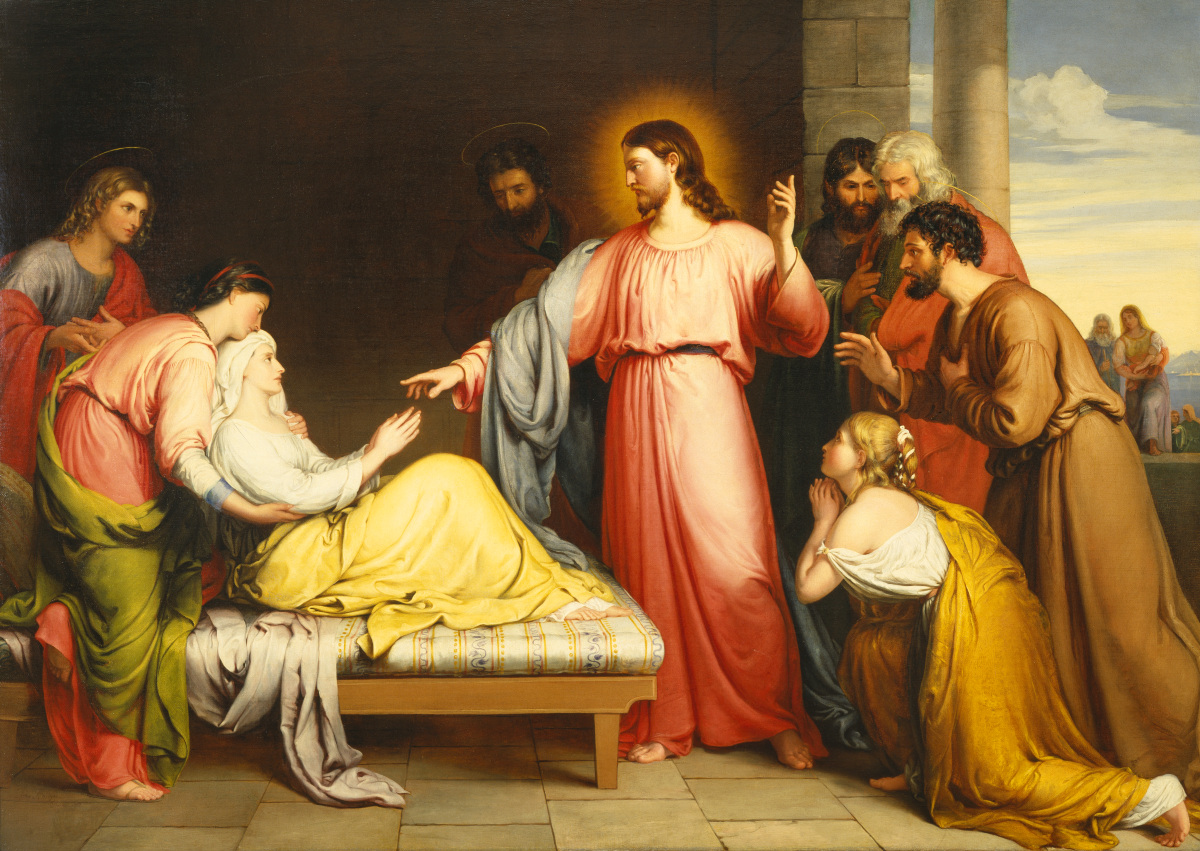
29 And immediately going out of the synagogue they came into the house of Simon and Andrew, with James and John.
30 And Simon’s wife’s mother lay in a fit of a fever: and forthwith they tell him of her.
31 And coming to her, he lifted her up, taking her by the hand; and immediately the fever left her, and she ministered unto them.
32 And when it was evening, after sunset, they brought to him all that were ill and that were possessed with devils.
33 And all the city was gathered together at the door.
34 And he healed many that were troubled with divers diseases; and he cast out many devils, and he suffered them not to speak, because they knew him.
35 And rising very early, going out, he went into a desert place: and there he prayed.
36 And Simon, and they that were with him, followed after him.
37 And when they had found him, they said to him: All seek for thee.
38 And he saith to them: Let us go into the neighbouring towns and cities, that I may preach there also; for to this purpose am I come.
39 And he was preaching in their synagogues, and in all Galilee, and casting out devils.
29 Et protinus egredientes de synagoga, venerunt in domum Simonis et Andreæ, cum Jacobo et Joanne.
30 Decumbebat autem socrus Simonis febricitans: et statim dicunt ei de illa.
31 Et accedens elevavit eam, apprehensa manu ejus: et continuo dimisit eam febris, et ministrabat eis.
32 Vespere autem facto cum occidisset sol, afferebant ad eum omnes male habentes, et dæmonia habentes:
33 et erat omnis civitas congregata ad januam.
34 Et curavit multos, qui vexabantur variis languoribus, et dæmonia multa ejiciebat, et non sinebat ea loqui, quoniam sciebant eum.
35 Et diluculo valde surgens, egressus abiit in desertum locum, ibique orabat.
36 Et prosecutus est eum Simon, et qui cum illo erant.
37 Et cum invenissent eum, dixerunt ei: Quia omnes quærunt te.
38 Et ait illis: Eamus in proximos vicos, et civitates, ut et ibi prædicem: ad hoc enim veni.
39 Et erat prædicans in synagogis eorum, et in omni Galilæa, et dæmonia ejiciens.

A Daily Question from the Summa Theologica
Whether it was becoming that Christ should lead an austere life in this world? (Article 2 of 4 of Question 40. Of Christ’s Manner of Life from the Treatise on the Incarnation)
Objection 1: It would seem that it was becoming that Christ should lead an austere life in this world. For Christ preached the perfection of life much more than John did. But John led an austere life in order that he might persuade men by his example to embrace a perfect life; for it is written (Mat. 3:4) that “the same John had his garment of camel’s hair and a leathern girdle about his loins: and his meat was locusts and wild honey”; on which Chrysostom comments as follows (Hom. x): “It was a marvelous and strange thing to behold such austerity in a human frame: which thing also particularly attracted the Jews.” Therefore it seems that an austere life was much more becoming to Christ.
Objection 2: Further, abstinence is ordained to continency; for it is written (Osee 4:10): “They shall eat and shall not be filled; they have committed fornication, and have not ceased.” But Christ both observed continency in Himself and proposed it to be observed by others when He said (Mat. 19:12): “There are eunuchs who have made themselves eunuchs for the kingdom of heaven: he that can take it let him take it.” Therefore it seems that Christ should have observed an austere life both in Himself and in His disciples.
Objection 3: Further, it seems absurd for a man to begin a stricter form of life and to return to an easier life: for one might quote to his discredit that which is written, Lk. 14:30: “This man began to build, and was not able to finish.” Now Christ began a very strict life after His baptism, remaining in the desert and fasting for “forty days and forty nights.” Therefore it seems unbecoming that, after leading such a strict life, He should return to the common manner of living.
On the contrary, It is written (Mat. 11:19): “The Son of Man came eating and drinking.”
I answer that, As stated above (A[1]), it was in keeping with the end of the Incarnation that Christ should not lead a solitary life, but should associate with men. Now it is most fitting that he who associates with others should conform to their manner of living; according to the words of the Apostle (1 Cor. 9:22): “I became all things to all men.” And therefore it was most fitting that Christ should conform to others in the matter of eating and drinking. Hence Augustine says (Contra Faust. xvi) that “John is described as ‘neither eating nor drinking,’ because he did not take the same food as the Jews. Therefore, unless our Lord had taken it, it would not be said of Him, in contrast, ‘eating and drinking.’”
Reply to Objection 1: In His manner of living our Lord gave an example of perfection as to all those things which of themselves relate to salvation. Now abstinence in eating and drinking does not of itself relate to salvation, according to Rom. 14:17: “The kingdom of God is not meat and drink.” And Augustine (De Qq. Evang. ii, qu. 11) explains Mat. 11:19, “Wisdom is justified by her children,” saying that this is because the holy apostles “understood that the kingdom of God does not consist in eating and drinking, but in suffering indigence with equanimity,” for they are neither uplifted by affluence, nor distressed by want. Again (De Doctr. Christ. iii), he says that in all such things “it is not making use of them, but the wantonness of the user, that is sinful.” Now both these lives are lawful and praiseworthy—namely, that a man withdraw from the society of other men and observe abstinence; and that he associate with other men and live like them. And therefore our Lord wished to give men an example of either kind of life.
As to John, according to Chrysostom (Hom. xxxvii super Matth.), “he exhibited no more than his life and righteous conduct . . . but Christ had the testimony also of miracles. Leaving, therefore, John to be illustrious by his fasting, He Himself came the opposite way, both coming unto publicans’ tables and eating and drinking.”
Reply to Objection 2: Just as by abstinence other men acquire the power of self-restraint, so also Christ, in Himself and in those that are His, subdued the flesh by the power of His Godhead. Wherefore, as we read Mat. 9:14, the Pharisees and the disciples of John fasted, but not the disciples of Christ. On which Bede comments, saying that “John drank neither wine nor strong drink: because abstinence is meritorious where the nature is weak. But why should our Lord, whose right by nature it is to forgive sins, avoid those whom He could make holier than such as abstain?”
Reply to Objection 3: As Chrysostom says (Hom. xiii super Matth.), “that thou mightest learn how great a good is fasting, and how it is a shield against the devil, and that after baptism thou shouldst give thyself up, not to luxury, but to fasting—for this cause did He fast, not as needing it Himself, but as teaching us . . . And for this did He proceed no further than Moses and Elias, lest His assumption of our flesh might seem incredible.” The mystical meaning, as Gregory says (Hom. xvi in Evang.), is that by Christ’s example the number “forty” is observed in His fast, because the power of the “decalogue is fulfilled throughout the four books of the Holy Gospel: since ten multiplied by four amounts to forty.” Or, because “we live in this mortal body composed of the four elements, and by its lusts we transgress the commandments of the Lord, which are expressed in the decalogue.” Or, according to Augustine (QQ. lxxxiii, qu. 81): “To know the Creator and the creature is the entire teaching of wisdom. The Creator is the Trinity, the Father, the Son, and the Holy Ghost. Now the creature is partly invisible, as the soul, to which the number three may be ascribed, for we are commanded to love God in three ways, ‘with our whole heart, our whole soul, and our whole mind’; and partly visible, as the body, to which the number four is applicable on account of its being subject to heat, moisture, cold, and dryness. Hence if we multiply ten, which may be referred to the entire moral code, by four, which number may be applied to the body, because it is the body that executes the law, the product is the number forty: in which,” consequently, “the time during which we sigh and grieve is shown forth.” And yet there was no inconsistency in Christ’s returning to the common manner of living, after fasting and (retiring into the) desert. For it is becoming to that kind of life, which we hold Christ to have embraced, wherein a man delivers to others the fruits of his contemplation, that he devote himself first of all to contemplation, and that he afterwards come down to the publicity of active life by associating with other men. Hence Bede says on Mk. 2:18: “Christ fasted, that thou mightest not disobey the commandment; He ate with sinners, that thou mightest discern His sanctity and acknowledge His power.”
Continue reading the rest of the articles on Sacred Texts Archive website.