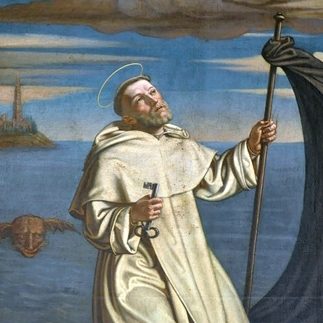
Optional Memorial of Saint Raymond of Peñafort, Priest
Liturgical Color: White
Rosary Mysteries: Glorious Mysteries
“Your purity of life, your devotion, deserve and call for a reward; because you are acceptable and pleasing to God your purity of life must be made purer still, by frequent buffetings, until you attain perfect sincerity of heart.”
Saint Raymond of Peñafort
est. 1175 – January 6, 1275
Patron of lawyers, canon lawyers, and Barcelona

Daily Readings
First Reading: 1 John 4: 11-18
11 My dearest, if God hath so loved us; we also ought to love one another.
12 No man hath seen God at any time. If we love one another, God abideth in us, and his charity is perfected in us.
13 In this we know that we abide in him, and he in us: because he hath given us of his spirit.
14 And we have seen, and do testify, that the Father hath sent his Son to be the Saviour of the world.
15 Whosoever shall confess that Jesus is the Son of God, God abideth in him, and he in God.
16 And we have known, and have believed the charity, which God hath to us. God is charity: and he that abideth in charity, abideth in God, and God in him.
17 In this is the charity of God perfected with us, that we may have confidence in the day of judgment: because as he is, we also are in this world.
18 Fear is not in charity: but perfect charity casteth out fear, because fear hath pain. And he that feareth, is not perfected in charity.
11 Carissimi, si sic Deus dilexit nos: et nos debemus alterutrum diligere.
12 Deum nemo vidit umquam. Si diligamus invicem, Deus in nobis manet, et caritas ejus in nobis perfecta est.
13 In hoc cognoscimus quoniam in eo manemus, et ipse in nobis: quoniam de Spiritu suo dedit nobis.
14 Et nos vidimus, et testificamur quoniam Pater misit Filium suum Salvatorem mundi.
15 Quisquis confessus fuerit quoniam Jesus est Filius Dei, Deus in eo manet, et ipse in Deo.
16 Et nos cognovimus, et credidimus caritati, quam habet Deus in nobis. Deus caritas est: et qui manet in caritate, in Deo manet, et Deus in eo.
17 In hoc perfecta est caritas Dei nobiscum, ut fiduciam habeamus in die judicii: quia sicut ille est, et nos sumus in hoc mundo.
18 Timor non est in caritate: sed perfecta caritas foras mittit timorem, quoniam timor pœnam habet: qui autem timet, non est perfectus in caritate.
Gospel: Mark 6: 45-52
45 And immediately he obliged his disciples to go up into the ship, that they might go before him over the water to Bethsaida, whilst he dismissed the people.
46 And when he had dismissed them, he went up to the mountain to pray.
47 And when it was late, the ship was in the midst of the sea, and himself alone on the land.
48 And seeing them labouring in rowing, (for the wind was against them,) and about the fourth watch of the night, he cometh to them walking upon the sea, and he would have passed by them.
49 But they seeing him walking upon the sea, thought it was an apparition, and they cried out.
50 For they all saw him, and were troubled. And immediately he spoke with them, and said to them: Have a good heart, it is I, fear ye not.
51 And he went up to them into the ship, and the wind ceased: and they were far more astonished within themselves:
52 For they understood not concerning the loaves; for their heart was blinded.
45 Et statim coëgit discipulos suos ascendere navim, ut præcederent eum trans fretum ad Bethsaidam, dum ipse dimitteret populum.
46 Et cum dimisisset eos, abiit in montem orare.
47 Et cum sero esset, erat navis in medio mari et ipse solus in terra.
48 Et videns eos laborantes in remigando (erat enim ventus contrarius eis) et circa quartam vigiliam noctis venit ad eos ambulans supra mare: et volebat præterire eos.
49 At illi ut viderunt eum ambulantem supra mare, putaverunt phantasma esse, et exclamaverunt.
50 Omnes enim viderunt eum, et conturbati sunt. Et statim locutus est cum eis, et dixit eis: Confidite, ego sum: nolite timere.
51 Et ascendit ad illos in navim, et cessavit ventus. Et plus magis intra se stupebant:
52 non enim intellexerunt de panibus: erat enim cor eorum obcæcatum.

A Daily Question from the Summa Theologica
Whether it was fitting that John should baptize? (Article 1 of 6 of Question 38. Of the Baptism of John from the Treatise on the Incarnation)
Objection 1: It would seem that it was not fitting that John should baptize. For every sacramental rite belongs to some law. But John did not introduce a new law. Therefore it was not fitting that he should introduce the new rite of baptism.
Objection 2: Further, John “was sent by God . . . for a witness” (John 1:6, 7) as a prophet; according to Lk. 1:76: “Thou, child, shalt be called the prophet of the Highest.” But the prophets who lived before Christ did not introduce any new rite, but persuaded men to observe the rites of the Law. as is clearly stated Malachi 4:4: “Remember the law of Moses My servant.” Therefore neither should John have introduced a new rite of baptism.
Objection 3: Further, when there is too much of anything, nothing should be added to it. But the Jews observed a superfluity of baptisms; for it is written (Mark 7:3, 4) that “the Pharisees and all the Jews eat not without often washing their hands . . . and when they come from the market, unless they be washed, they eat not; and many other things there are that have been delivered to them to observe, the washings of cups and of pots, and of brazen vessels, and of beds.” Therefore it was unfitting that John should baptize.
On the contrary is the authority of Scripture (Matt. 3:5, 6), which, after stating the holiness of John, adds many went out to him, “and were baptized in the Jordan.”
I answer that, It was fitting for John to baptize, for four reasons: first, it was necessary for Christ to be baptized by John, in order that He might sanctify baptism; as Augustine observes, super Joan. (Tract. xiii in Joan.).
Secondly, that Christ might be manifested. Whence John himself says (Jn. 1:31): “That He,” i.e. Christ, “may be made manifest in Israel, therefore am I come baptizing with water.” For he announced Christ to the crowds that gathered around him; which was thus done much more easily than if he had gone in search of each individual, as Chrysostom observes, commenting on St. John (Hom. x in Matth.).
Thirdly, that by his baptism he might accustom men to the baptism of Christ; wherefore Gregory says in a homily (Hom. vii in Evang.) that therefore did John baptize, “that, being consistent with his office of precursor, as he had preceded our Lord in birth, so he might also by baptizing precede Him who was about to baptize.”
Fourthly, that by persuading men to do penance, he might prepare men to receive worthily the baptism of Christ. Wherefore Bede [*Cf. Scot. Erig. in Joan. iii, 24] says that “the baptism of John was as profitable before the baptism of Christ, as instruction in the faith profits the catechumens not yet baptized. For just as he preached penance, and foretold the baptism of Christ, and drew men to the knowledge of the Truth that hath appeared to the world, so do the ministers of the Church, after instructing men, chide them for their sins, and lastly promise them forgiveness in the baptism of Christ.”
Reply to Objection 1: The baptism of John was not a sacrament properly so called [per se], but a kind of sacramental, preparatory to the baptism of Christ. Consequently, in a way, it belonged to the law of Christ, but not to the law of Moses.
Reply to Objection 2: John was not only a prophet, but “more than a prophet,” as stated Mat. 11:9: for he was the term of the Law and the beginning of the Gospel. Therefore it was in his province to lead men, both by word and deed, to the law of Christ rather than to the observance of the Old Law.
Reply to Objection 3: Those baptisms of the Pharisees were vain, being ordered merely unto carnal cleanliness. But the baptism of John was ordered unto spiritual cleanliness, since it led men to do penance, as stated above.
Continue reading the rest of the articles on Sacred Texts Archive website.