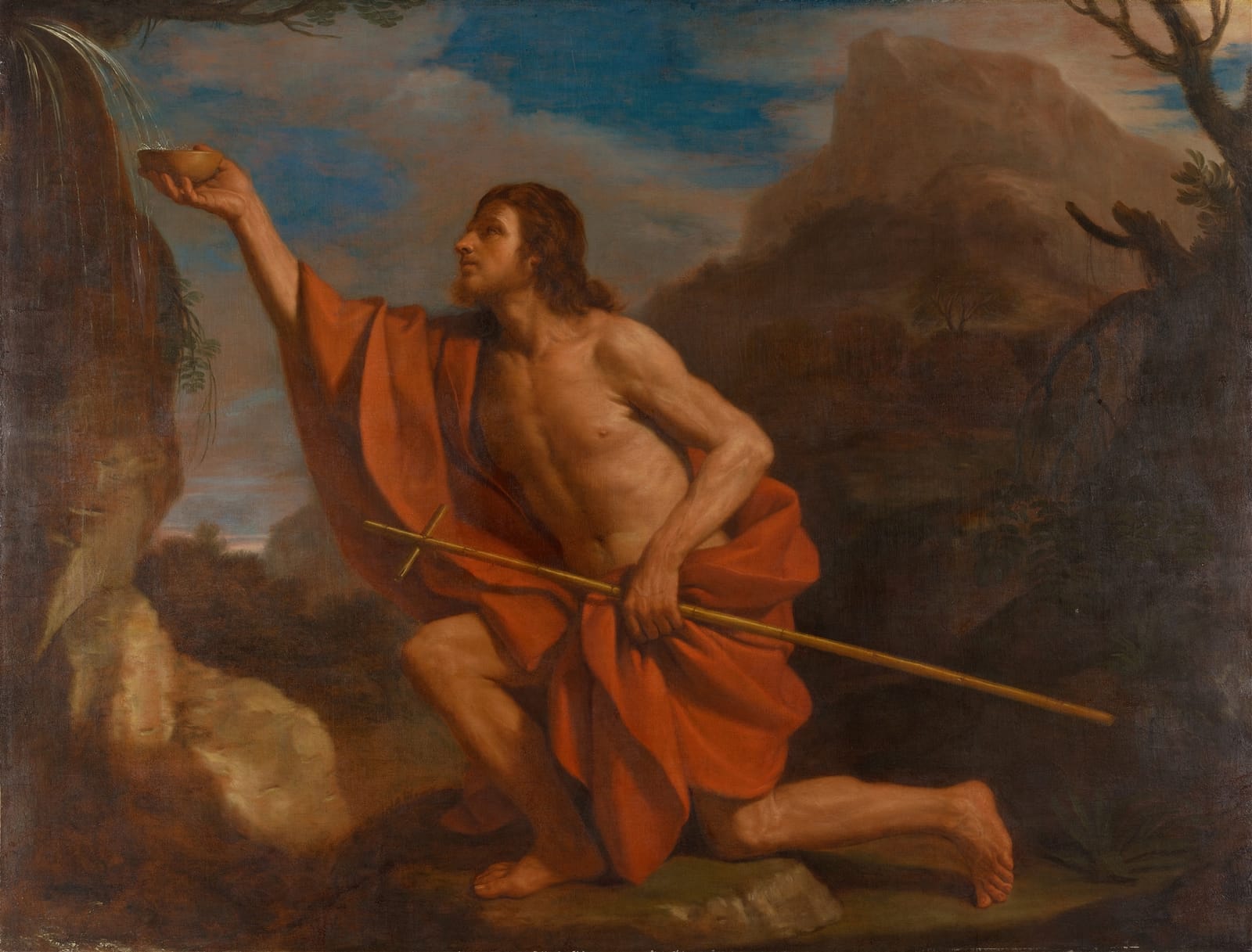
Easter Weekday
LITurgical Color: White
Rosary Mysteries: Sorrowful Mysteries

Daily Readings
John 1: 15-28
15 John beareth witness of him, and crieth out, saying: This was he of whom I spoke: He that shall come after me, is preferred before me: because he was before me.
16 And of his fulness we all have received, and grace for grace.
17 For the law was given by Moses; grace and truth came by Jesus Christ.
18 No man hath seen God at any time: the only begotten Son who is in the bosom of the Father, he hath declared him.
19 And this is the testimony of John, when the Jews sent from Jerusalem priests and Levites to him, to ask him: Who art thou?
20 And he confessed, and did not deny: and he confessed: I am not the Christ.
21 And they asked him: What then? Art thou Elias? And he said: I am not. Art thou the prophet? And he answered: No.
22 They said therefore unto him: Who art thou, that we may give an answer to them that sent us? What sayest thou of thyself?
23 He said: I am the voice of one crying out in the wilderness, make straight the way of the Lord, as said the prophet Isaias.
24 And they that were sent, were of the Pharisees.
25 And they asked him, and said to him: Why then dost thou baptize, if thou be not Christ, nor Elias, nor the prophet?
26 John answered them, saying: I baptize with water; but there hath stood one in the midst of you, whom you know not.
27 The same is he that shall come after me, who is preferred before me: the latchet of whose shoe I am not worthy to loose.
28 These things were done in Bethania, beyond the Jordan, where John was baptizing.
15 Joannes testimonium perhibet de ipso, et clamat dicens: Hic erat quem dixi: Qui post me venturus est, ante me factus est: quia prior me erat.
16 Et de plenitudine ejus nos omnes accepimus, et gratiam pro gratia:
17 quia lex per Moysen data est, gratia et veritas per Jesum Christum facta est.
18 Deum nemo vidit umquam: unigenitus Filius, qui est in sinu Patris, ipse enarravit.]
19 Et hoc est testimonium Joannis, quando miserunt Judæi ab Jerosolymis sacerdotes et Levitas ad eum ut interrogarent eum: Tu quis es?
20 Et confessus est, et non negavit, et confessus est: Quia non sum ego Christus.
21 Et interrogaverunt eum: Quid ergo? Elias es tu? Et dixit: Non sum. Propheta es tu? Et respondit: Non.
22 Dixerunt ergo ei: Quis es ut responsum demus his qui miserunt nos? quid dicis de teipso?
23 Ait: Ego vox clamantis in deserto: Dirigite viam Domini, sicut dixit Isaias propheta.
24 Et qui missi fuerant, erant ex pharisæis.
25 Et interrogaverunt eum, et dixerunt ei: Quid ergo baptizas, si tu non es Christus, neque Elias, neque propheta?
26 Respondit eis Joannes, dicens: Ego baptizo in aqua: medius autem vestrum stetit, quem vos nescitis.
27 Ipse est qui post me venturus est, qui ante me factus est: cujus ego non sum dignus ut solvam ejus corrigiam calceamenti.
28 Hæc in Bethania facta sunt trans Jordanem, ubi erat Joannes baptizans.

A Daily Question from the Summa Theologica
Whether it was fitting for Christ to rise again on the third day? (Article 1 of 4 of Question 53. Of Christ’s Resurrection from the Treatise on the Incarnation)
Objection 1: It would seem unfitting that Christ should have risen again on the third day. For the members ought to be in conformity with their head. But we who are His members do not rise from death on the third day, since our rising is put off until the end of the world. Therefore, it seems that Christ, who is our head, should not have risen on the third day, but that His Resurrection ought to have been deferred until the end of the world.
Objection 2: Further, Peter said (Acts 2:24) that “it was impossible for Christ to be held fast by hell” and death. Therefore it seems that Christ’s rising ought not to have been deferred until the third day, but that He ought to have risen at once on the same day; especially since the gloss quoted above (A[1]) says that “there is no profit in the shedding of Christ’s blood, if He did not rise at once.”
Objection 3: The day seems to start with the rising of the sun, the presence of which causes the day. But Christ rose before sunrise: for it is related (Jn. 20:1) that “Mary Magdalen cometh early, when it was yet dark, unto the sepulchre”: but Christ was already risen, for it goes on to say: “And she saw the stone taken away from the sepulchre.” Therefore Christ did not rise on the third day.
On the contrary, It is written (Mat. 20:19): “They shall deliver Him to the Gentiles to be mocked, and scourged, and crucified, and the third day He shall rise again.”
I answer that, As stated above (A[1]) Christ’s Resurrection was necessary for the instruction of our faith. But our faith regards Christ’s Godhead and humanity, for it is not enough to believe the one without the other, as is evident from what has been said (Q[36], A[4]; cf. SS, Q[2], AA[7],8). Consequently, in order that our faith in the truth of His Godhead might be confirmed it was necessary that He should rise speedily, and that His Resurrection should not be deferred until the end of the world. But to confirm our faith regarding the truth of His humanity and death, it was needful that there should be some interval between His death and rising. For if He had risen directly after death, it might seem that His death was not genuine and consequently neither would His Resurrection be true. But to establish the truth of Christ’s death, it was enough for His rising to be deferred until the third day, for within that time some signs of life always appear in one who appears to be dead whereas he is alive.
Furthermore, by His rising on the third day, the perfection of the number “three” is commended, which is “the number of everything,” as having “beginning, middle, and end,” as is said in De Coelo i. Again in the mystical sense we are taught that Christ by “His one death” (i.e. of the body) which was light, by reason of His righteousness, “destroyed our two deaths” (i.e. of soul and body), which are as darkness on account of sin; consequently, He remained in death for one day and two nights, as Augustine observes (De Trin. iv).
And thereby is also signified that a third epoch began with the Resurrection: for the first was before the Law; the second under the Law; and the third under grace. Moreover the third state of the saints began with the Resurrection of Christ: for, the first was under figures of the Law; the second under the truth of faith; while the third will be in the eternity of glory, which Christ inaugurated by rising again.
Reply to Objection 1: The head and members are likened in nature, but not in power; because the power of the head is more excellent than that of the members. Accordingly, to show forth the excellence of Christ’s power, it was fitting that He should rise on the third day, while the resurrection of the rest is put off until the end of the world.
Reply to Objection 2: Detention implies a certain compulsion. But Christ was not held fast by any necessity of death, but was “free among the dead”: and therefore He abode a while in death, not as one held fast, but of His own will, just so long as He deemed necessary for the instruction of our faith. And a task is said to be done “at once” which is performed within a short space of time.
Reply to Objection 3: As stated above (Q[51], A[4], ad 1,2), Christ rose early when the day was beginning to dawn, to denote that by His Resurrection He brought us to the light of glory; just as He died when the day was drawing to its close, and nearing to darkness, in order to signify that by His death He would destroy the darkness of sin and its punishment. Nevertheless He is said to have risen on the third day, taking day as a natural day which contains twenty-four hours. And as Augustine says (De Trin. iv): “The night until the dawn, when the Lord’s Resurrection was proclaimed, belongs to the third day. Because God, who made the light to shine forth from darkness, in order that by the grace of the New Testament and partaking of Christ’s rising we might hear this—‘once ye were darkness, but now light in the Lord’—insinuates in a measure to us that day draws its origin from night: for, as the first days are computed from light to darkness on account of man’s coming fall, so these days are reckoned from darkness to light owing to man’s restoration.” And so it is evident that even if He had risen at midnight, He could be said to have risen on the third day, taking it as a natural day. But now that He rose early, it can be affirmed that He rose on the third day, even taking the artificial day which is caused by the sun’s presence, because the sun had already begun to brighten the sky. Hence it is written (Mk. 16:2) that “the women come to the sepulchre, the sun being now risen”; which is not contrary to John’s statement “when it was yet dark,” as Augustine says (De Cons. Evang. iii), “because, as the day advances the more the light rises, the more are the remaining shadows dispelled.” But when Mark says “‘the sun being now risen,’ it is not to be taken as if the sun were already apparent over the horizon, but as coming presently into those parts.”
Continue reading the rest of the articles on Sacred Texts Archive website.